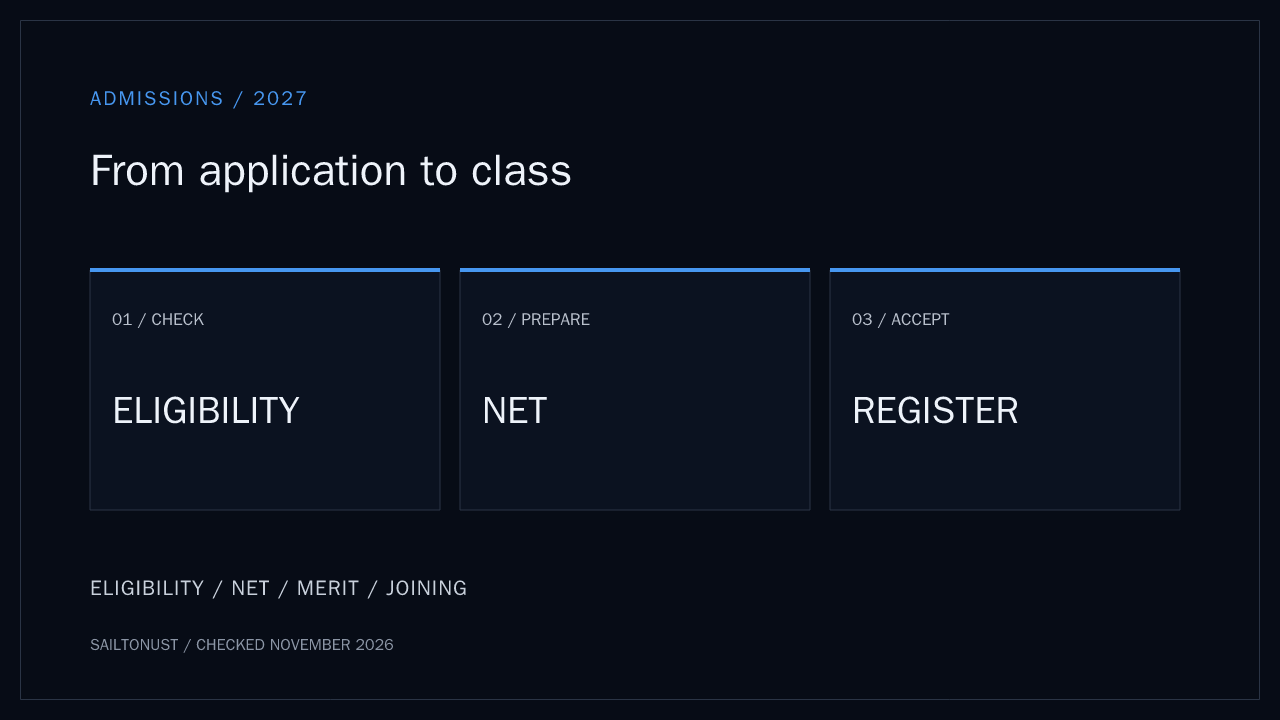
For NUST admission in 2027, check programme eligibility, register for the correct NET paper, complete payment and testing, then follow merit selection and joining instructions. Admission, financial aid and hostel accommodation require separate attention. This guide connects each step with its official source and the relevant SailToNUST checklist, as of November 2026.
Key facts
- Eligibility floor: at least 60% each in SSC and completed HSSC or accepted equivalents.
- NET merit formula: NET 75%, HSSC 15%, SSC 10%.
- NUST lists four NET series. Each needs its own registration.
- Published academic fees currently cover 2026-27, not a guaranteed Fall 2027 bill.
Source: NUST UG admissions portal, dates, eligibility, merit and selection pages; 2026-27 financial matters; checked November 2026
1. Check eligibility for the actual degree
Start with NUST's eligibility requirements, then read the programme eligibility guide. The percentage floor does not replace subject requirements. A high NET score cannot repair a missing compulsory subject.
FSc applicants can apply on Part-I marks while awaiting final results. They must still satisfy the completed qualification conditions before admission. Do not confuse the marks available for an application with the final documents needed at joining.
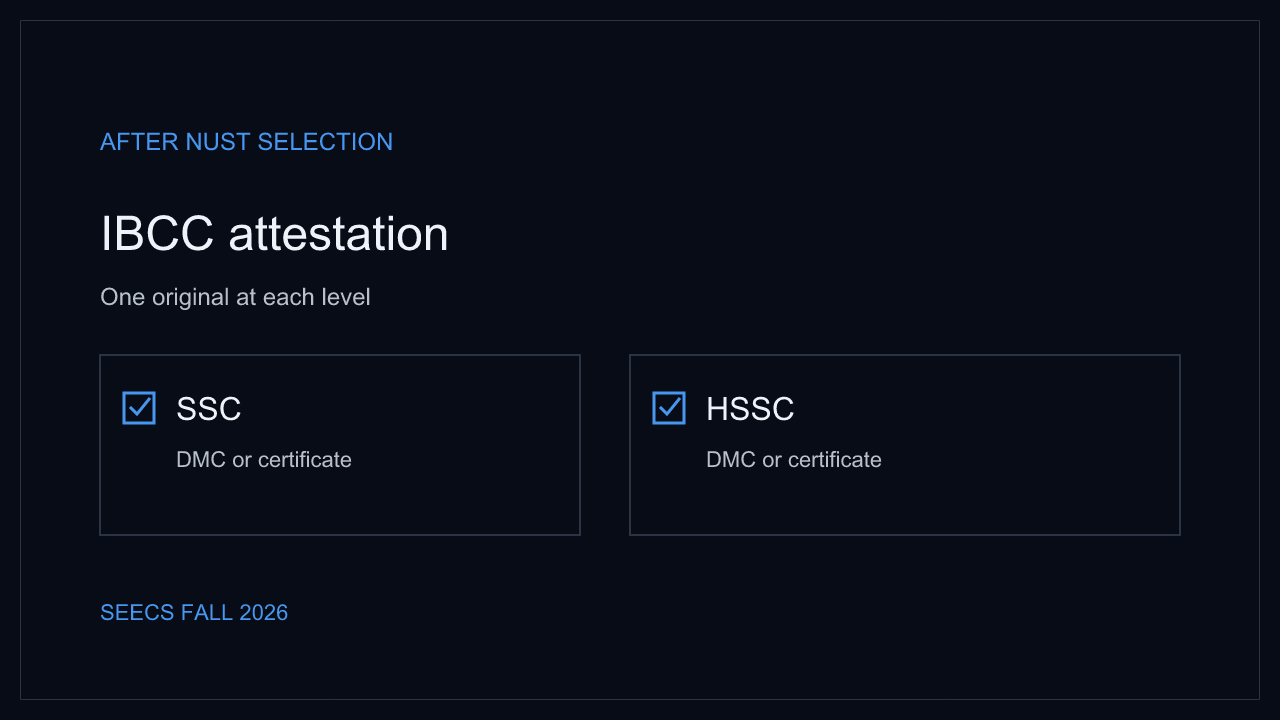
A-Level applicants should read the O/A-Level guide. Use accepted IBCC equivalence, not a home calculation from grades. Keep equivalence and attestation separate. Our IBCC attestation guide explains the document task for admission.
Pre-Medical and ICS applicants should check remedial or deficient-course conditions before choosing Engineering or Computing. Business admission also needs a programme-level check. A broad test category does not make every degree open to every subject combination.
2. Choose programmes and campuses together
A degree name does not tell you which NUST campus you would attend. Read the campus guide, then consider travel, accommodation and the school's courses before arranging preferences.
Use the programme guides for Computer Science, BBA, Electrical Engineering, Mechanical Engineering and Civil Engineering. For Architecture and Industrial Design, preparation must include the right Design Aptitude work.
Write down degrees you would accept. Then rank them in your true order of preference. Avoid adding a programme only because someone describes its merit as lower. An offer brings a payment deadline and a real decision about studying there.
3. Match the NET paper to your route
The paper-selection guide explains the mapping. These subject weights come from the site's verified NET facts, which cite NUST's weightings page.
| Paper | Subject percentages |
|---|---|
| NET-Engineering | Mathematics 50%, Physics 30%, English 20% |
| NET-Applied Sciences | Biology 50%, Chemistry 30%, English 20% |
| NET-Business and Social Sciences | Quantitative Mathematics 50%, English 50% |
| NET-Architecture | Design Aptitude 50%, Mathematics 30%, English 20% |
| NET-Natural Sciences | Mathematics 50%, English 50% |
Check your academic background as well as the programme. Some science degrees accept different papers through different qualification routes. Use the syllabus hub and paper-pattern explanation to identify what to study.
Our verified format records 200 MCQs in 180 minutes, with no negative marking. NUST publishes subject percentages. Any question counts calculated from those percentages are derived, rather than a separate official promise about a sitting.
4. Check the 2027 calendar before registering
Use SailToNUST's dates page and the 2027 series schedule. They link to NUST's tentative dates table. The detailed guide gives the current registration and test windows, including the first series that falls in 2026 for the 2027 intake.
The distinction matters: a registration deadline comes before the testing period. Your account and admit card give your own appointment. Do not treat a start date for testing as the day every applicant must arrive.
Later series can have month windows rather than exact days. Check your intended city before planning travel. Islamabad and Quetta use computer-based testing; Karachi and Gilgit use paper-based testing. Not every centre appears in every series.
Check the linked schedule again before paying or arranging travel. Read which series to choose and CBNET versus PBNET before booking transport.
5. Register, pay and check your appointment
Create your application at the official undergraduate portal. Follow the registration guide while entering personal details, marks, paper and programme choices. Check your spelling and identity information against the documents you will later submit.
The verified national or dual-national NET application fee is Rs 5,000 per exam. That is separate from the university admission processing fee paid after selection. Follow the payment instructions generated by the portal, retain the receipt and check the application's status afterward.
A separate series needs a separate application. Do not assume that paying once registers you for all four series. If you plan to retake, use the repeat-attempt guide and budget each attempt and trip.
Use your own email account and check it throughout the cycle. Keep a folder for the form, payment proof and admit card. Save files somewhere you can access when travelling, rather than relying on one message in an inbox.
6. Submit financial aid before its deadline
The aid form is a separate submission. Read the financial-aid guide and NUST's NFAAF instructions while completing admission registration.
The instructions tie the aid deadline to the NET application deadline. Saving sections does not submit the form. Collect the household evidence early enough to resolve missing documents and check the final submission status.
An aid request is not an award. Ask what a confirmed offer covers and how its timing relates to dues. Keep a payment plan for admission and first-semester charges while NUST assesses the application.
7. Prepare with work you can review
For Engineering, start with SailToNUST full papers to find gaps under time pressure. Review uncertain correct answers as well as mistakes. Then choose chapter practice for the concepts that caused those errors.
Use past MCQs as practice material and read what past-paper claims mean. Do not treat a remembered question collection as an official future paper. For computer-based sittings, practise the controls through the simulator and NUST's official sample test.
The three-month plan, 30-day plan and last-week guide help you choose a routine for the time available. Students taking other papers should match practice to their own subjects, rather than assume Engineering full papers cover their whole test.
8. Take the test and check your result
Before travelling, follow the test-day checklist and your admit card's instructions. Use the correct centre and reporting time. Keep the identity documents specified for your own sitting ready.
After testing, use the result-checking guide. The site's verified facts record roughly 24 hours for computer-based results and five to seven working days for paper-based results. Check the portal rather than treating a classmate's result notification as your own deadline.
If the score falls short of your preparation target, review it before choosing another series. The second-attempt guide helps you identify what must change. Repeating the same unreviewed practice is not a plan for gaining marks.
9. Calculate merit and follow selection
For NET-based admission, use:
aggregate = (NET / 200) x 75 + HSSC percentage x 0.15 + SSC percentage x 0.10
The merit formula guide explains the final-year A-Level case, where O-Level equivalence carries 25%. Enter the qualification status that applies to you in the aggregate calculator.
An aggregate is not an admission offer. Read closing merit and merit lists to distinguish a historical closing position from a future threshold. Applicant choices and available seats affect selection.
Follow NUST's selection instructions for preferences, offers and dues. If selected, use the deadline in your own letter. Do not wait for a hoped-for upgrade while leaving the current payment requirement unanswered.
10. Budget, accept the offer and arrange accommodation
The academic fee guide separates programme groups. The total semester cost guide adds worked H-12 living budgets and separates joining cash from later monthly mess payments. All amounts use dated official rates, which NUST can revise.
For accommodation, begin with hostel eligibility and allotment. Check room charges and mess charges separately. A university offer does not guarantee a hostel room. Keep a travel or housing backup while awaiting the allotment decision.
When an offer arrives, use the after-selection guide and the payment guide. Read each invoice's bank instructions. Paying admission dues does not automatically settle hostel rent or mess.
11. Complete school registration and hostel reporting
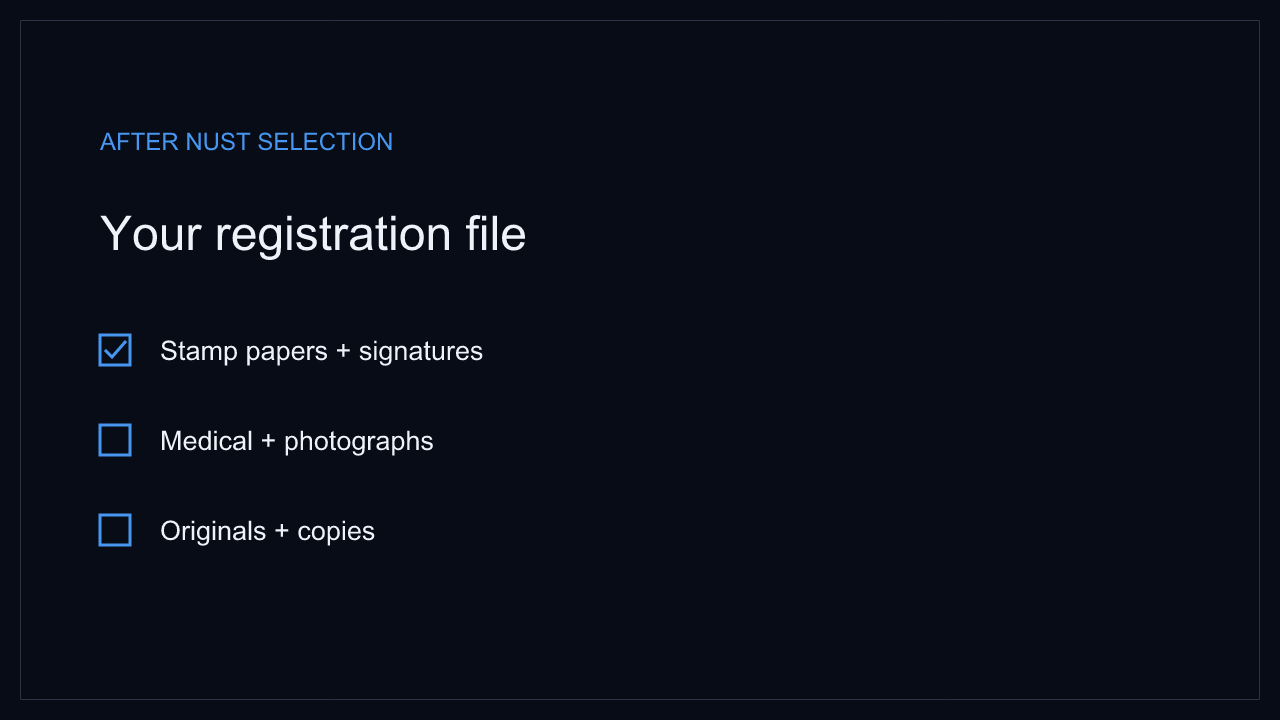
Use the registration document checklist alongside your school's joining letter. Arrange originals, attestation and medical documents as instructed. School registration and hostel reporting have separate files and may have different dates.
After receiving accommodation, use the hostel move-in checklist for your willing reply, paid slips and arrival forms. Then read the orientation guide. Do not mistake an orientation announcement for confirmation that academic registration is complete.
Check your Qalam profile once access arrives. Confirm the name, photograph and invoices belong to you. Keep receipts and official emails throughout the degree, so a missing payment or profile error can be traced to a dated record.
Other admission routes
Applicants using ACT or SAT need a separate application route and calendar. Read ACT/SAT admission before booking a test. Foreign and expatriate applicants should also read the foreign admission guide. National-student PKR budgets do not establish an international-seat invoice.