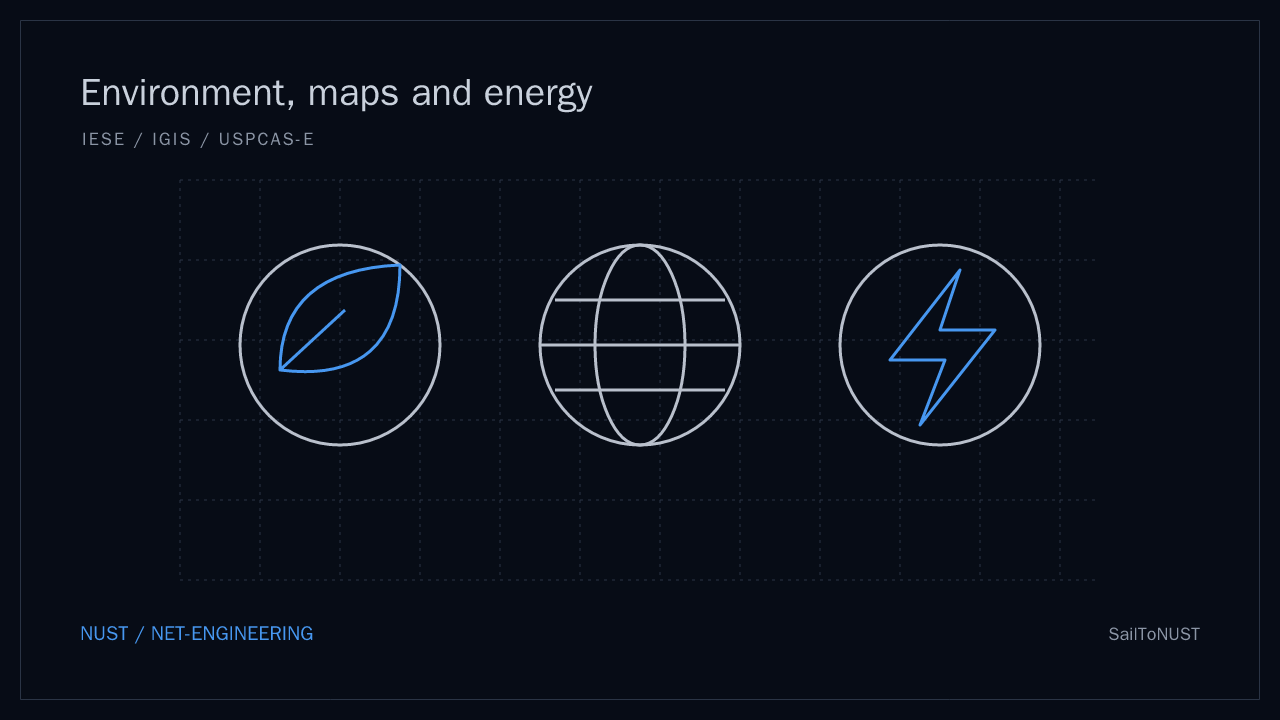
NUST lists Environmental Engineering at SCEE-IESE, Geoinformatics Engineering at SCEE-IGIS and Energy Engineering at USPCAS-E in Islamabad as of November 2026. All use NET-Engineering, but they address different problems, so rank them by the work you want to learn rather than treating them as interchangeable backups.
Three engineering choices
- Environmental: IESE within SCEE. Geoinformatics: IGIS within SCEE.
- Energy: USPCAS-E, which lists BE Energy on its own programme page.
- Paper for these engineering choices: Maths 50%, Physics 30%, English 20%.
Source: NUST UG programme list and eligibility; IESE, IGIS and USPCAS-E programme pages; src/lib/net-facts.ts; checked November 2026
2026 closing merit positions
| Programme | Institute | Code | 2026 closing position |
|---|---|---|---|
| BE Geoinformatics | IGIS | G636 | 4579 |
| BE Environmental Engineering | IESE | E609 | 6013 |
| BE Energy Engineering (new in 2026) | USPCAS-E | U6007 | 5035 |
Source: NUST Admissions Directorate, 14th merit selection list, UG 2026. These are ranks within the relevant merit pool, not marks or aggregate percentages. See all NUST closing merit 2026 positions for the full record and guidance on preferences.
Where each programme sits
The official NUST list uses SCEE for Environmental and Geoinformatics Engineering. The institute sites identify the teaching units more precisely.
| Programme | Unit | Main comparison question |
|---|---|---|
| Environmental Engineering | IESE, SCEE | Do treatment systems, pollution control and environmental design interest me? |
| Geoinformatics Engineering | IGIS, SCEE | Do mapping, location data and remote sensing interest me? |
| Energy Engineering | USPCAS-E | Do I want to study energy technologies and systems? |
Use the campus guide for location planning. Then compare the schemes rather than assuming that studying in Islamabad makes these equivalent choices.
What distinguishes the curricula?
IESE's Fall 2025 onward engineering scheme includes fluid mechanics, water treatment and supply design, wastewater treatment, solid waste management and pollution control. Environmental Engineering is therefore worth investigating if you want to design systems that address environmental problems.
Do not confuse it with BS Environmental Science. IESE lists both, and NUST places the science degree in a different admissions category. Check the exact programme title before deciding which paper and eligibility row apply.
IGIS's Fall 2025 onward scheme includes GIS, remote sensing, digital mapping, spatial databases and GIS programming. Its mix of location information and computing is distinct from a general CS course. Ask whether you want to work with spatial questions, rather than selecting it because it contains programming.
The USPCAS-E programme page lists BE Energy. Its department introduction still describes a planned undergraduate launch. The central admissions list and programme menu establish the listed option, but applicants should request the current BE scheme directly before assuming particular modules, specialisations or intake arrangements.
Read the Electrical Engineering guide for a nearby energy-related alternative. The Civil Engineering guide helps with the infrastructure comparison. Neither comparison should replace reading the actual scheme you would join.
Eligibility and the NET paper
The engineering eligibility rules require 60% each in SSC and HSSC or accepted equivalence. For ICS with Maths, Physics and Computer Science, Chemistry is remedial in semester one. Pre-Medical applicants without additional Maths must clear NUST's eight-week Mathematics course before admission.
The NET-2027 update sets the course deadline before 25 July 2027 and requires 60%. Keep that separate from NET revision: passing an entry test does not complete an outstanding qualification condition. Check the notice again when applying for a later intake.
NET-Engineering weights are Mathematics 50%, Physics 30%, English 20%. The paper has 200 MCQs in 180 minutes. Chemistry is not a section in this paper, even when your degree or remedial requirement involves it. Use the NET syllabus to plan test revision.
How to rank these options
Write one example problem you would like to solve for each degree. For Environmental Engineering, that might be a water-treatment design. For Geoinformatics, it might be analysing flood exposure on a map. For Energy, it might be comparing energy-system choices. These examples test your interest; they do not promise a particular final-year project.
Next, list the compulsory courses you would least enjoy. If you would avoid most of them, the programme is a weak backup even if its name sounds useful. Ask each institute about recent projects and undergraduate lab work before settling your order.
NUST's NET-based aggregate weights NET at 75%, HSSC at 15% and SSC at 10%. Enter your own results in the aggregate calculator. Use the merit-list guide to understand offers and preferences. A previous closing position cannot promise your admission this year.
How to prepare for these programmes' NET paper on SailToNUST
Start from the syllabus, then practise your weakest Maths chapters on SailToNUST. Review Physics across the syllabus instead of studying only topics that sound connected to energy or the environment. Keep English in every full-paper rehearsal.