BS Psychology at NUST is an undergraduate degree at S3H, Islamabad, within the Department of Behavioural Sciences. As of November 2026, applicants can come from any HSSC or equivalent subject combination, and the NET route tests Quantitative Mathematics and English rather than Biology or Psychology.
Key facts
- School: School of Social Sciences and Humanities, Islamabad.
- Department: Behavioural Sciences.
- Academic floor: 60% each in SSC and HSSC or equivalent.
- NET-Business and Social Sciences: quantitative maths 50%, English 50%.
Source: NUST UG qualification and institution lists; S3H Behavioural Sciences department and BS research page; NET facts from src/lib/net-facts.ts; checked November 2026
2026 closing merit positions
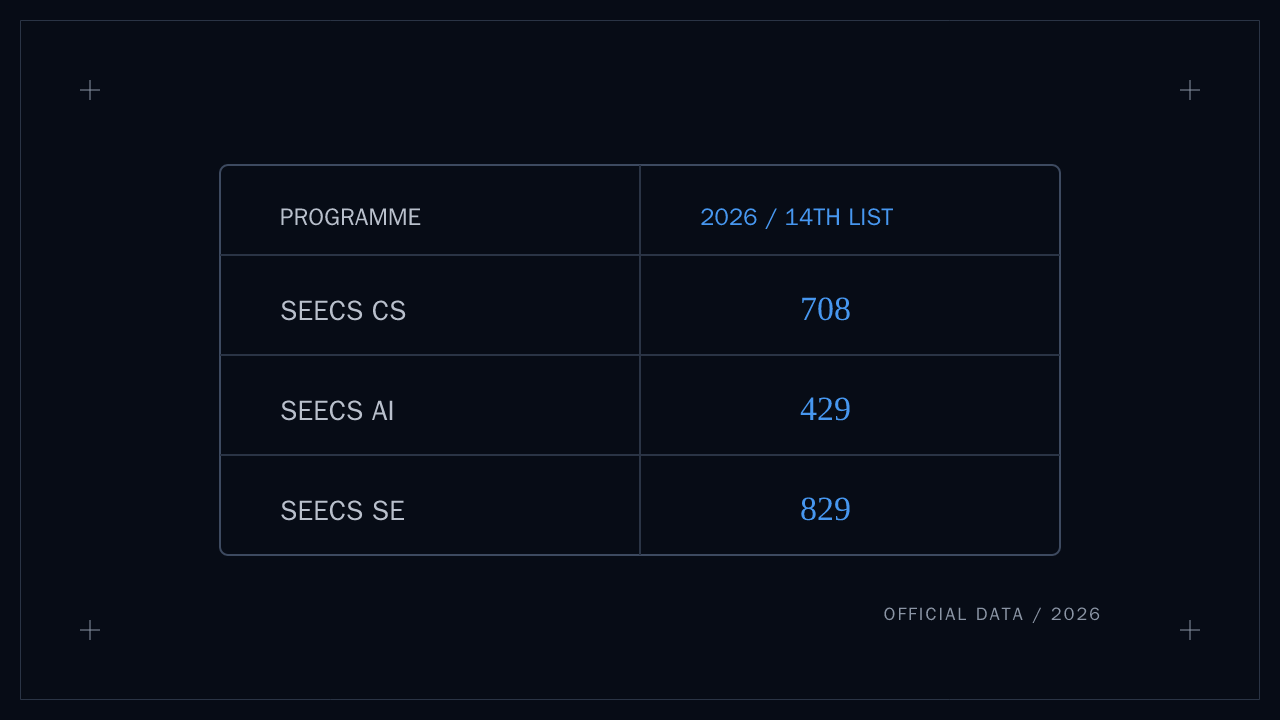
BS Psychology at S3H (H662) closed at merit position 1884 on the 14th merit selection list for UG 2026.
Source: NUST Admissions Directorate, 14th merit selection list, UG 2026. These are ranks within the relevant merit pool, not marks or aggregate percentages. See all NUST closing merit 2026 positions for the full record and guidance on preferences.
What you are choosing
The Behavioural Sciences department describes its field around how people think and behave in different social and cultural settings. Its account connects psychology with other behavioural disciplines and gives research a clear place in the department's work.
You can inspect the published BS Psychology research projects to see examples of student questions. Listed projects examine topics such as academic burnout, parenting styles and student adjustment, and psychological measurement. These examples show the kind of question students investigate. They do not guarantee that the same supervisor or topic will remain available for a later cohort.
Read these projects before choosing the degree because you enjoy giving advice to friends. A better interest check is whether you want to examine evidence about behaviour, question an explanation and write about what the evidence can support.
For the school around the programme, read the S3H guide. Use the official programme index to find the Fall 2025 onwards scheme rather than relying on an older course list.
Psychology versus related options
| Programme | A useful question for the applicant |
|---|---|
| Psychology | Do I want to investigate thinking and behaviour through evidence? |
| Mass Communication | Do I want to study media, messages, audiences and production? |
| Liberal Arts and Humanities | Do I want study across philosophy, history, culture and literature? |
| Economics | Do I want economic theory and applied economic research? |
These questions help you read the official descriptions. They are not claims about which degree has the highest salary. The Mass Communication guide explains its media focus, while the Economics guide explains the research focus of that option.
If your goal is clinical work, investigate that path separately. S3H lists an MS Clinical Psychology alongside the undergraduate degree. A postgraduate programme title does not establish what a BS graduate may practise independently. Ask the department about further study and supervised training requirements for your intended role. This guide makes no clinical practice or licensing claim.
Which school backgrounds are eligible?
NUST's qualification table lists Psychology for Pre-Medical, Pre-Engineering, ICS and non-science combinations. FA and Commerce applicants can also apply under the any-combination condition. Prior school Psychology is not a mandatory subject in that rule.
The minimum remains 60% each in SSC and HSSC or equivalent. For foreign qualifications, use IBCC equivalence rather than translating your grades into a guessed percentage. Read the A-Level admissions guide if you apply through that route.
Pre-Medical students should separate eligibility from test choice. Biology may be familiar, but the paper for this programme is Business and Social Sciences. Preparing the Applied Sciences paper because of your college group would prepare the wrong subject mix for Psychology.
What NET applicants need to study
The repo's NET facts give this paper two equal halves: Quantitative Mathematics 50% and English 50%. Check the official weighting table. There is no separate Psychology section to revise for NET.
The 200-question test lasts 180 minutes. Equal subject weights give a derived split of 100 quantitative maths and 100 English MCQs. NUST publishes the weights, not those section counts.
If you have not studied maths recently, use short untimed sets to find your gaps before setting a speed target. Keep English in the same week. Completing a maths chapter does not compensate for leaving half the admission paper untouched.
Use the aggregate calculator to connect your marks to possible NET scores. Consult the merit-list guide for selection rather than treating a circulating closing figure as a guarantee.
How to prepare for this programme's NET paper on SailToNUST
Follow the Business maths preparation plan. Start with number systems and sets, then work on arithmetic errors before timing mixed questions. For English, use vocabulary practice and the English guide.
SailToNUST's full-length papers currently use the Engineering pattern. For Psychology, use the quantitative maths and English chapters for targeted practice. Review wrong answers and uncertain correct answers before starting another set.