BS Mass Communication at NUST is an undergraduate degree at S3H, Islamabad, covering media study and practice. As of November 2026, NUST accepts any HSSC or equivalent subject combination for admission, and NET applicants prepare the Business and Social Sciences paper with equal weights for Quantitative Mathematics and English.
Key facts
- School: S3H, Islamabad.
- Academic groups: any HSSC or equivalent combination.
- Minimum academic marks: 60% each in SSC and HSSC or equivalent.
- NET subjects: quantitative maths 50%, English 50%.
Source: NUST UG qualification and institution lists; S3H Mass Communication department and programme index; NET facts from src/lib/net-facts.ts; checked November 2026
2026 closing merit positions
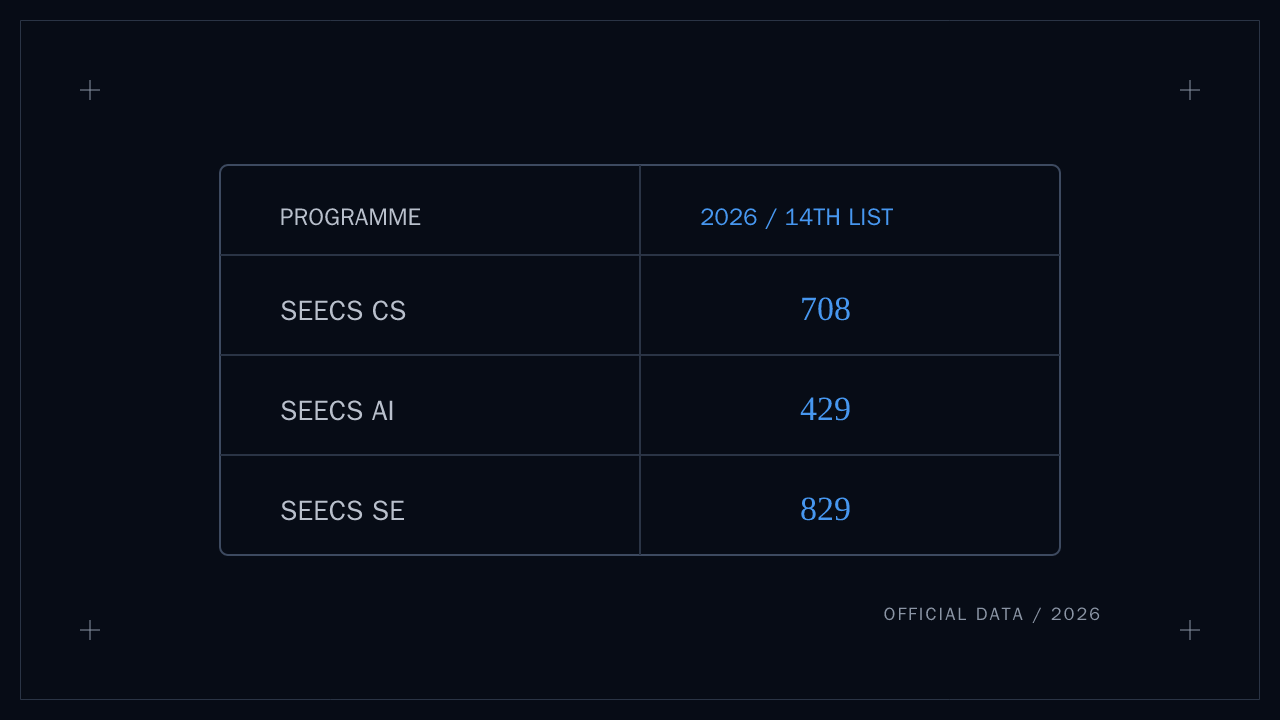
BS Mass Communication at S3H (H638) closed at merit position 2449 on the 14th merit selection list for UG 2026.
Source: NUST Admissions Directorate, 14th merit selection list, UG 2026. These are ranks within the relevant merit pool, not marks or aggregate percentages. See all NUST closing merit 2026 positions for the full record and guidance on preferences.
What the degree covers
The S3H Mass Communication department describes teaching in production, journalism, advertising, public relations, research and digital media. It also describes practical opportunities through internships and research projects, plus student media facilities including radio, television, podcast recording and editing.
Those details help distinguish a communication degree from the idea of simply appearing on camera. You should also want to examine how messages work, how people receive them and how evidence supports what a communicator publishes. Read the department's account alongside the current course scheme before making a preference decision.
The S3H programme index lists a Fall 2025 onwards scheme separately from earlier versions. Use the correct cohort label. A list copied from an old prospectus may describe a previous student's degree rather than yours.
For wider school information, use the S3H guide. This post keeps the focus on admission, programme fit and the paper you need to prepare.
How it differs from nearby degrees
| Degree | Compare this kind of work before choosing |
|---|---|
| Mass Communication | Media research, reporting, production and communication practice |
| Psychology | Research questions about thinking and behaviour |
| Liberal Arts and Humanities | Reading and argument across humanities disciplines |
| BBA | Business study through the NBS programme scheme |
A student interested in advertising should compare the Mass Communication description with the BBA guide. Ask whether the main interest lies in making and studying communication or in the broader business behind an organisation. That question is more useful than choosing whichever title sounds more familiar.
Similarly, an interest in how audiences react can lead you to compare Psychology. Read both official schemes. Shared interests do not mean that either course can substitute for the other.
Which career directions does the school name?
The department names production, journalism, communication research, public relations, advertising and digital media as possible career directions. These are the school's stated fields, not employment guarantees or a verified salary range.
If one field interests you, ask the department for examples of recent student work in it. Ask what kind of internship a student can seek and what practical work the current scheme requires. Assess the answers against the work you want to learn, rather than assuming a studio alone determines training quality.
This guide does not claim a placement rate. NUST's department description supports the fields above but does not give a verified outcome for each incoming student.
Eligibility for science, FA and Commerce applicants
NUST's official qualification table includes Mass Communication for science and non-science backgrounds. Pre-Engineering, Pre-Medical, ICS, FA and Commerce applicants can apply under the any-combination condition.
The academic minimum is 60% each in SSC and HSSC or equivalent. O/A-Level and other foreign qualifications need IBCC equivalence under the official eligibility rules. You do not need a school subject called Mass Communication to satisfy the published combination rule.
Check costs before ranking programmes. The fee guide explains the fee categories and links the current notice. Do not infer that a media degree has the same bill as an Engineering degree.
Which NET paper is for Mass Communication?
Use NET-Business and Social Sciences. The repo's NET facts give Quantitative Mathematics 50% and English 50%, matching the official weights. Neither media production nor current-affairs recall is a named subject in this paper.
The full paper has 200 MCQs and 180 minutes. A 100 and 100 subject split is derived from the published percentages. Applicants from FA should therefore plan maths practice, while science applicants should give English its full share of study time.
How to prepare for this programme's NET paper on SailToNUST
Start with the Business maths preparation plan. Use averages and arithmetic practice to check ratios, percentages and word-problem setup. Pair it with the English preparation guide and chapter questions.
After each set, write down why the answer failed. Distinguish a missed calculation from a misunderstood sentence. Repair that error before increasing speed. SailToNUST's full papers currently cover Engineering, so use its relevant subject banks rather than treating those papers as Mass Communication admission mocks.