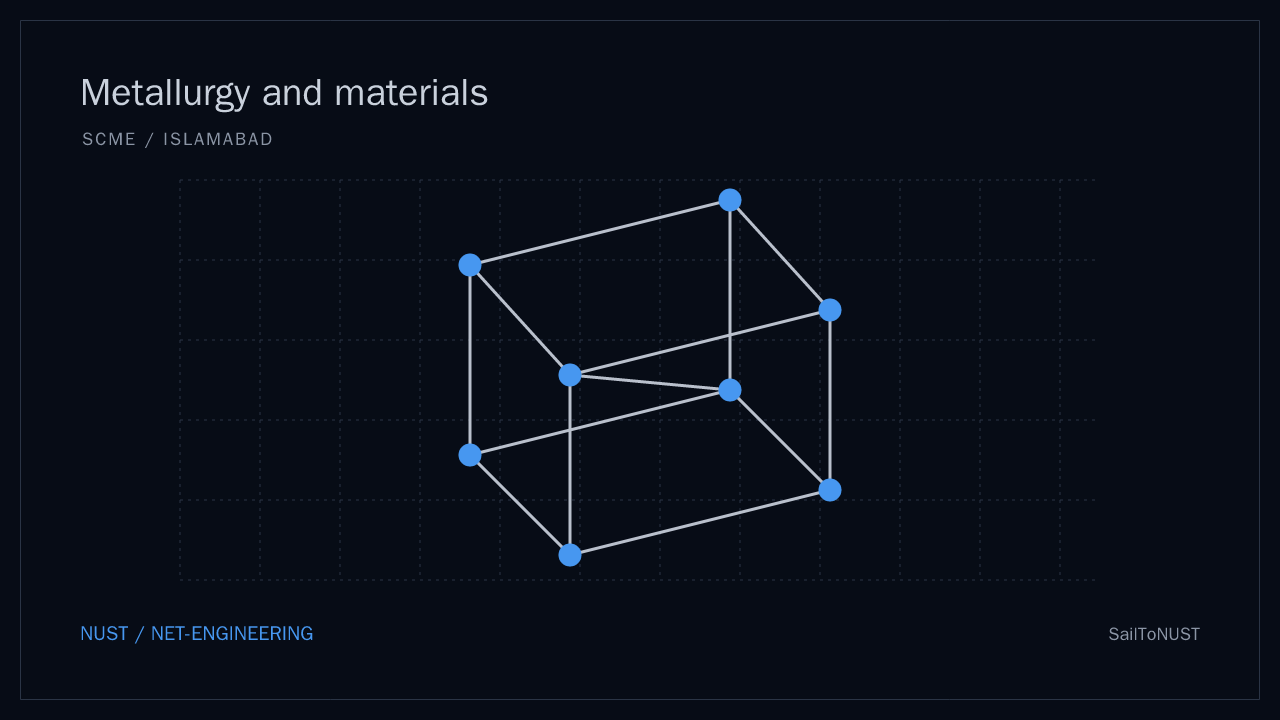
NUST offers Metallurgy and Materials Engineering at SCME in Islamabad, according to its official undergraduate list as of November 2026. Applicants use NET-Engineering, so the entry paper remains Maths, Physics and English even though materials is a separate degree choice from Chemical Engineering.
Metallurgy and materials at a glance
- School: School of Chemical and Materials Engineering, Islamabad.
- Programme: Metallurgy and Materials Engineering, separate from Chemical Engineering.
- Paper: NET-Engineering, Maths 50%, Physics 30%, English 20%.
Source: NUST UG programme list and eligibility; SCME academic programme pages; src/lib/net-facts.ts; checked November 2026
2026 closing merit positions
BE Metallurgy and Materials Engineering at SCME (C626) closed at merit position 6148 on the 14th merit selection list for UG 2026.
Source: NUST Admissions Directorate, 14th merit selection list, UG 2026. These are ranks within the relevant merit pool, not marks or aggregate percentages. See all NUST closing merit 2026 positions for the full record and guidance on preferences.
Find the degree at SCME
The official NUST list names SCME for this programme. SCME's academic programme page lists undergraduate Metallurgy and Materials Engineering alongside Chemical Engineering.
Use that programme page to locate the scheme for your intake. Check the year on an outline before assuming it applies to a new admission cycle. If an individual course page does not load, request the current scheme from SCME rather than filling the gap with another university's curriculum.
Read the campus guide for the Islamabad setting. Follow the fee guide for budgeting and confirm the current official charges before paying. Being in the same school as another degree does not make the academic choices identical.
Materials, chemical or mechanical engineering?
A useful way to investigate this choice is to ask what you want to understand about an engineered object. Are you interested in the material itself, the process that makes a product, or the machine that uses it? Use the answers to guide your reading of the schemes.
| Programme to compare | Questions to take to its curriculum |
|---|---|
| Metallurgy and Materials Engineering | Do I want to investigate material behaviour, processing and selection? |
| Chemical Engineering | Do industrial processes and the movement or conversion of substances interest me? |
| Mechanical Engineering | Do machines, mechanical design and thermal systems interest me? |
These questions are comparison advice, not a claim that one programme owns every related topic. Read the Chemical Engineering guide for the other SCME degree. Read the Mechanical Engineering guide if you are deciding between materials and machines.
When comparing outlines, mark the required laboratory courses and project requirements. Ask SCME for recent undergraduate project examples. A project description can help you judge whether you want to spend time investigating a material problem, while a broad claim about "scope" gives you little to test.
Eligibility and the NET paper
The engineering eligibility rules require 60% each in SSC and HSSC or accepted equivalence. For ICS with Maths, Physics and Computer Science, Chemistry is remedial in semester one. Pre-Medical applicants without additional Maths must clear NUST's eight-week Mathematics course before admission.
The NET-2027 update sets the course deadline before 25 July 2027 and requires 60%. Keep that separate from NET revision: passing an entry test does not complete an outstanding qualification condition. Check the notice again when applying for a later intake.
NET-Engineering weights are Mathematics 50%, Physics 30%, English 20%. The paper has 200 MCQs in 180 minutes. Chemistry is not a section in this paper, even when your degree or remedial requirement involves it. Use the NET syllabus to plan test revision.
The Chemistry condition for ICS concerns eligibility after admission. It does not add Chemistry MCQs to NET-Engineering. Keep a separate checklist for qualification requirements and another for the chapters you need to revise for the test.
How to rank metallurgy and materials
Rank this programme highly if the scheme and project work fit an interest you want to pursue. Do not list it only because you want any degree at H-12. Ask whether you would still accept the offer if a later transfer never happened.
NUST's NET-based aggregate weights NET at 75%, HSSC at 15% and SSC at 10%. Enter your own results in the aggregate calculator. Use the merit-list guide to understand offers and preferences. A previous closing position cannot promise your admission this year.
Compare it with Chemical Engineering on required work rather than a shared school name. Compare it with Mechanical Engineering on the questions you want to solve. If both appeal to you, write down your reason for preferring one before looking at old closing figures. That keeps an uncertain admission estimate from deciding your interests for you.
How to prepare for this programme's NET paper on SailToNUST
Build your revision list from the NET syllabus. Use Maths practice for weak chapters, then Physics practice for the errors your baseline paper exposed. Include English instead of spending all your time on the subjects that sound closest to the degree.
Review each full paper before opening the next one. Separate a forgotten formula from a calculation error and a misread question. Those causes need different corrections. Return to timed practice after you have repaired the chapter, so the next score tests a change in your preparation.