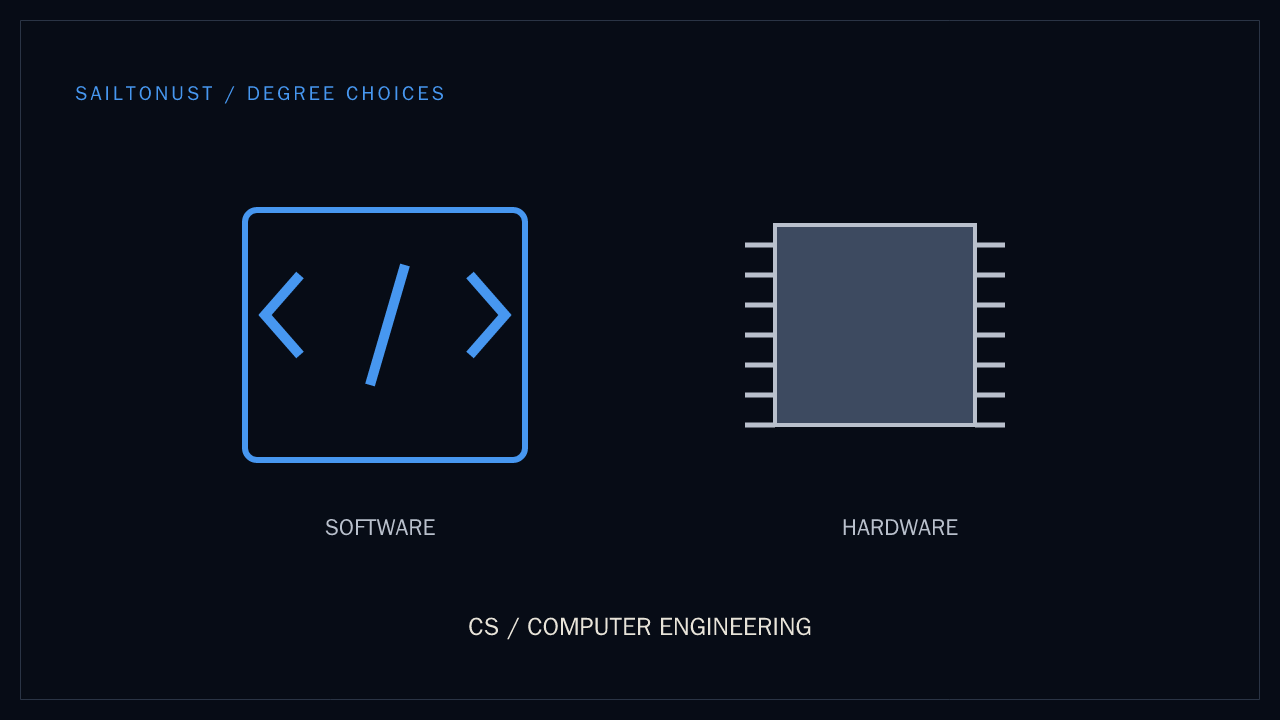
Computer science focuses on computation and software; computer engineering connects computing with electronic hardware and embedded systems. At NUST, choose between them by comparing the actual study plans and the kind of project you want to build, rather than assuming one title guarantees a better job.
Key facts
- NUST lists both Computer Science and Computer Engineering.
- Both routes use NET-Engineering under the site's verified paper rules.
- Degree titles alone do not establish a salary ranking.
Source: NUST undergraduate programme list and SEECS programme catalogue; NET facts from the SailToNUST net-facts register; checked November 2026
Start with the work you want to do
Imagine building a small weather station. Writing the application that stores readings and makes them searchable is a software problem. Connecting a sensor to a processor and making it work within memory and power limits brings in computer engineering questions. Both involve code, but the constraints differ.
This example is a decision exercise, not a claim that either NUST department assigns that project. Try each part before deciding that you love or dislike an entire subject. A programming exercise and a basic digital-logic simulation can reveal more than a social-media ranking.
| Decision | Computer science | Computer engineering |
|---|---|---|
| Main interest to test | Algorithms, software and computation | Hardware, digital systems and software together |
| Project to try | Searchable application with a database | Sensor or processor simulation with code |
| Question to ask about courses | How much theory and systems work will I study? | How much electronics and laboratory work will I study? |
| Weak reason to choose | Everyone says CS has scope | The word engineering sounds safer |
Use this table as a starting point. The SEECS programme catalogue publishes intake-specific study plans. Read the plan for your entry year before counting compulsory courses or electives.
Where the NUST programmes sit
As of November 2026, the NUST undergraduate list places Computer Engineering at CoEME and SEECS. It lists Computer Science at SEECS, NBC and PNEC. Check the application portal for the choices open in your admission cycle.
Campus matters alongside the title. Work out where you would live, how you would travel and whether you can afford the total cost. Do not rank a Rawalpindi programme as though you would attend every class at H-12. The campus guide helps you separate the locations.
For CS eligibility and application details, read the NUST CS admission guide. If your actual choice is CS against Software Engineering, use the separate NUST SE versus CS comparison. That is a different decision from choosing a hardware-focused degree.
Compare compulsory courses before electives
Make a sheet with the compulsory modules from each current study plan. Mark the courses you would willingly study even if the job market changed. Then mark the ones you would accept only to reach an elective later.
A degree with a desirable final-year elective can still be a poor fit if you dislike its required laboratory work. Likewise, a broad software interest does not remove the need to study mathematics or theoretical concepts in CS. Ask departments how they offer electives and confirm whether a listed option actually runs.
Ask students for examples of work: a laboratory report, project brief or reading list they can share. Their experience can help you frame questions. It cannot replace an official scheme or prove what your own batch will study.
Can either degree lead to software work?
Do not treat a programme name as an employment restriction or a job offer. When assessing a software role, compare its requirements with the programming, algorithms and project evidence you can build during your degree. A Computer Engineering student considering software work should make that comparison early.
For hardware-focused work, check the required electronics, digital design and laboratory background. A CS student should not assume a short online course replaces every hardware prerequisite. Ask what the role demands before planning a switch.
There is no verified salary comparison in this guide. An experienced engineer's offer and a graduate developer's offer do not establish which undergraduate degree pays more. You would need a dated survey with comparable roles, locations and experience levels.
How to prepare for these programmes' NET paper on SailToNUST
NET-Engineering weights Mathematics at 50%, Physics at 30% and English at 20%, according to the site's paper guide. Choosing CS does not remove Physics from your preparation.
Open the syllabus, attempt a SailToNUST full paper and list the chapters behind your errors. Repair one topic at a time in chapter practice, then return to timed work. Use the aggregate calculator to test score scenarios without mistaking them for admission guarantees.