SNS is NUST's School of Natural Sciences at H-12 in Islamabad, offering BS Mathematics, BS Physics and BS Chemistry. The correct NET depends on your academic background, so applying to SNS does not automatically mean taking NET-Natural Sciences.
That distinction matters before you buy books or build a timetable. Use the paper selection guide with this school guide, and the campus guide for location context.
Key facts
- Undergraduate degrees: Mathematics, Physics and Chemistry.
- NET-Natural Sciences is for eligible applicants outside the standard defined streams.
- Engineering and Applied Sciences routes can also lead to eligible SNS choices.
Source: NUST programme list, eligibility table, NET weightings and SNS Chemistry department; checked November 2026
2026 closing merit positions
| Programme | Institute | Code | 2026 closing position |
|---|---|---|---|
| BS Mathematics | SNS | N619 | 1950 |
| BS Physics | SNS | N630 | 1885 |
| BS Chemistry | SNS | N659 | 2309 |
Source: NUST Admissions Directorate, 14th merit selection list, UG 2026. These are ranks within the relevant merit pool, not marks or aggregate percentages. See all NUST closing merit 2026 positions for the full record and guidance on preferences.
What SNS teaches
As of November 2026, NUST's undergraduate list places these degrees at SNS. Compare their schemes on the school website before ranking them together.
| Degree | Question for your curriculum comparison |
|---|---|
| BS Mathematics | Do I want mathematical reasoning to be the main subject of my degree? |
| BS Physics | Do I want to study physical theory alongside experimental work? |
| BS Chemistry | Do I want chemical science and laboratory investigation to anchor my studies? |
A science degree and an engineering degree may share some early topics. Their later courses can lead in different directions. Do not treat BS Physics as a renamed Electrical Engineering degree, or Chemistry as Chemical Engineering with fewer admission hurdles.
Start by reading the compulsory courses beyond the first year. Then inspect project requirements and electives. If you want postgraduate research, find faculty working in a topic you can explain in your own words rather than selecting a school from a ranking alone.
Match background to paper
The repo's NET facts distinguish these possible paper routes. Eligibility for the degree remains a separate check.
| Applicant situation | Paper to check with NUST |
|---|---|
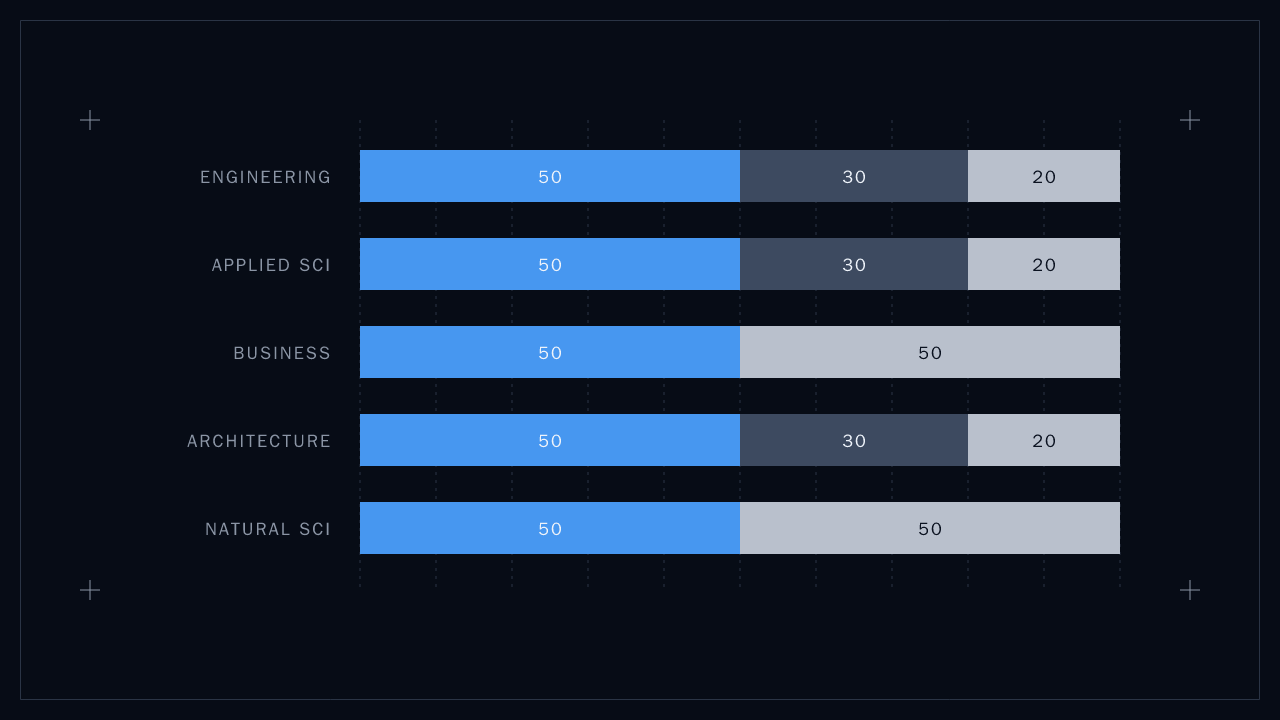
| Standard Engineering-route applicant also selecting eligible SNS degrees | NET-Engineering: Mathematics 50%, Physics 30%, English 20% |
| Pre-Medical applicant selecting eligible Physics or Chemistry choices | NET-Applied Sciences: Biology 50%, Chemistry 30%, English 20% |
| Eligible background outside NUST's standard defined streams | NET-Natural Sciences: Mathematics 50%, English 50% |
The official weighting page limits Natural Sciences to backgrounds outside the defined standard streams. Do not choose that paper merely because English is a stronger subject than Physics. Ask admissions to confirm the category if your combination does not fit the examples.
A paper covering a programme does not remove that programme's subject requirements. Plain Pre-Medical should not become an assumed BS Mathematics route simply because another SNS degree accepts the same applicant.
Check subject eligibility separately
NUST's eligibility table requires Mathematics for BS Mathematics. Chemistry needs Chemistry plus Mathematics or Physics. The qualification table lists BS Physics for candidates with Mathematics or Physics as a major subject. The eligibility page's Physics row uses unclear wording about two mandatory subjects. If your combination leaves doubt, request written confirmation from admissions.
The general NET academic floor is 60% in both SSC and HSSC or equivalent. Students using foreign qualifications should read the A-Level guide and arrange the relevant IBCC equivalence. A subject name on your transcript and an accepted equivalence group are different checks.
Facilities named on official pages
As of November 2026, the SNS Chemistry department describes chemical synthesis laboratories and instruments for spectroscopy, chromatography, mass spectrometry and X-ray crystallography. SNS also publishes a lab facilities page.
Ask which facilities support undergraduate practicals and which require a supervised research project. Advanced instruments on a department page do not mean every student independently operates each one. Your useful question is how the degree teaches measurement, safe laboratory work and interpretation of results.
For Mathematics, ask about computing in coursework and research projects rather than using wet-lab equipment as the only measure of a school. For Physics, request the current practical course list and ask how experiments connect to lecture topics.
How to prepare for this programme's NET paper on SailToNUST
For Engineering, use Maths, Physics and English, then take a relevant full paper. Review the chapters behind uncertain correct answers as well as wrong answers.
For Applied Sciences, use Biology, Chemistry and English. For Natural Sciences, practise Maths and English without importing the Engineering Physics weighting. SailToNUST's Engineering full papers cannot predict performance on those other paper mixes.