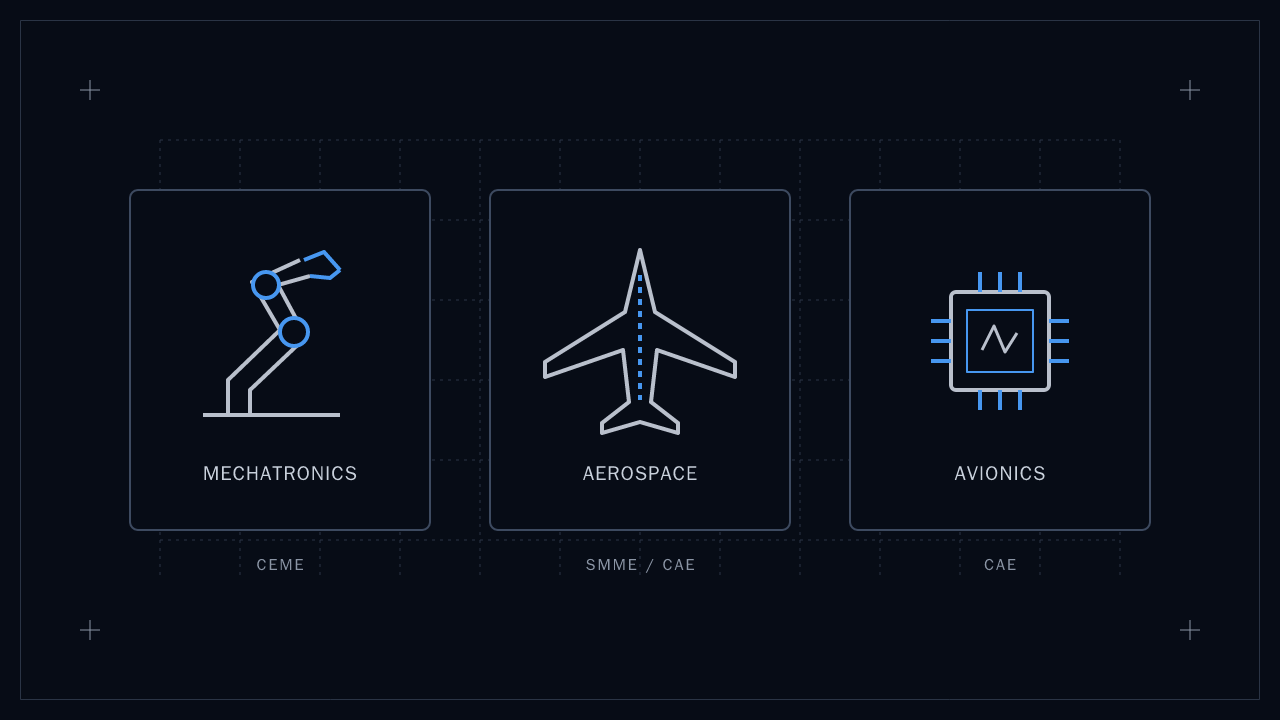
NUST offers Mechatronics at CEME, Aerospace at SMME and CAE, and Avionics at CAE, according to its official undergraduate programme list as of November 2026. All use NET-Engineering; NUST also lists BS Robotics and Artificial Intelligence at SMME and CEME for introduction in Fall 2027.
Programme and admissions facts
- CEME, also written CoEME: Rawalpindi. SMME: Islamabad. CAE: Risalpur.
- NET-Engineering: Mathematics 50%, Physics 30%, English 20%.
- BS Robotics and AI starts in Fall 2027, according to NUST's announcement.
- NUST excludes foreign nationals and international candidates from CAE's Aerospace and Avionics programmes.
Source: NUST undergraduate programme list, UG admissions updates, eligibility criteria, admissions policy and NET weightings; checked November 2026
2026 closing merit positions
| Programme | Institute | Code | 2026 closing position |
|---|---|---|---|
| BE Aerospace Engineering | SMME | M606 | 1720 |
| BE Aerospace Engineering | CAE | Z606 | 1810 |
| BE Avionics Engineering | CAE | Z607 | 3809 |
| BE Mechatronics Engineering | CEME | W615 | 2978 |
Source: NUST Admissions Directorate, 14th merit selection list, UG 2026. These are ranks within the relevant merit pool, not marks or aggregate percentages. See all NUST closing merit 2026 positions for the full record and guidance on preferences.
Where you would study
Use the NUST programme list to identify each programme and college together:
| Programme | College or school | City |
|---|---|---|
| Mechatronics Engineering | College of Electrical and Mechanical Engineering, CEME or CoEME | Rawalpindi |
| Aerospace Engineering | School of Mechanical and Manufacturing Engineering, SMME | Islamabad |
| Aerospace Engineering | College of Aeronautical Engineering, CAE | Risalpur |
| Avionics Engineering | CAE | Risalpur |
| BS Robotics and Artificial Intelligence | SMME and CoEME | Islamabad and Rawalpindi |
The UG admissions update dates Robotics and AI to Fall 2027. Its appearance on the list does not mean NUST already admitted a Fall 2026 cohort.
If you want the broader mechanical degree, read our mechanical engineering guide. Here the decision concerns automation, flight vehicles and aircraft electronics.
What separates the subjects
Mechatronics combines machines with electronics and control. CEME's department describes a mix of mechanical, computer, electronics and information sciences for automated and robotic systems. Consider it if you want to make a mechanism sense, move and respond. Robotics is part of that interest, but the degree also concerns industrial automation beyond robots.
Aerospace centres on the flight vehicle. SMME's department names aerodynamics, vehicle design, materials, structures, propulsion and systems engineering. Consider it if airflow, structural loads and engines interest you enough to study the mathematics behind them. An interest in aircraft photographs alone tells you little about whether you will enjoy those courses.
Avionics centres on aviation's electrical and electronic systems. CAE's department lists embedded electronics, computing, radar and communications, RF and microwave engineering, guidance, navigation, control and systems integration. Consider it if you care more about an aircraft's sensing, communication and electronic control than its wing or engine design.
These interests overlap. A drone needs structures, propulsion, sensors and control software. Choose the part you want to understand in depth. Our electrical engineering guide helps if the electronics interests you but an aviation focus does not.
For Robotics and AI, the verified announcement establishes the title, colleges and start term. It does not establish a placement record for the new BS. Compare the intake's published course scheme before treating it as a replacement for Mechatronics or assuming how much hardware it teaches.
Which NET should you prepare for?
Use NET-Engineering for all the choices here, including BS Robotics and Artificial Intelligence. The site's NET facts record the official subject weights: Mathematics 50%, Physics 30% and English 20%.
There is no separate Aerospace or Avionics NET paper. Your degree preference does not change those subject weights. Enjoying mechanics or circuits should not lead you to spend all your revision time on Physics when Mathematics carries half the paper.
Use the NET syllabus to plan coverage, then check your aggregate with the calculator. A score target and a preference list answer different questions: one guides preparation, while the other records which offer you would accept.
Check your academic route
NUST's eligibility page requires at least 60% each in SSC and HSSC or accepted equivalence. Engineering requires SSC Science and a qualifying HSSC group:
- Pre-Engineering, or Pre-Medical with additional Mathematics.
- Computer Science with Mathematics, Physics and Computer Science. Engineering entrants must clear remedial Chemistry in the first semester.
- Pre-Medical without additional Mathematics, subject to NUST's eight-week Mathematics course before admission.
Foreign qualifications need IBCC equivalence in the required group. Robotics and AI has a separate eligibility row accepting Pre-Engineering, Computer Science, Pre-Medical or HSSC with mandatory Mathematics. Its Pre-Medical route without additional Mathematics also requires the eight-week course.
The NET-2027 update requires engineering applicants taking that course to finish before 25 July 2027 with at least 60%. DAE applicants should check NUST's diploma-specific eligibility rather than assume every diploma qualifies for every engineering degree.
What CAE's official pages establish
CAE's history identifies the college as part of the PAF Academy in Risalpur and a constituent college of NUST. That affiliation matters when you investigate campus arrangements.
NUST's admissions policy explicitly excludes foreign nationals, non-Pakistanis and international candidates from Aerospace and Avionics at CAE. Keep the restriction attached to CAE; that statement does not announce an equivalent ban for SMME Aerospace.
Do not infer a PAF commission, service obligation, pilot medical standard or civilian uniform rule from the college's name. The official pages checked for this guide do not establish those conditions for an ordinary NET applicant. Ask CAE for the current joining instructions and terms for your admission category before ranking it. NUST's general eligibility page requires a medical certificate at joining; that requirement alone does not establish a pilot selection medical.
How to rank your preferences
Start with the coursework you would choose even if every option admitted you. Put Mechatronics higher for machines and automation, Aerospace for flight mechanics and vehicle design, or Avionics for aviation electronics. This is a way to match interests, not a NUST ranking.
Next compare the actual locations. For Aerospace, decide between SMME in Islamabad and CAE in Risalpur using course schemes, accommodation, travel costs and the college's written rules. Do not let a shared degree title erase those differences.
Keep Robotics and AI on your research list for Fall 2027. Request the BS course scheme and compare it with Mechatronics before placing one above the other. Then use our selection-list guide to understand offers and preferences. Include only programmes you would join; a speculative closing merit number cannot decide whether you want to study radar or aerodynamics.
How to prepare for this programme's NET paper on SailToNUST
Check your paper in the NET syllabus, then use the aggregate calculator to set a practice target from your own marks. Match practice to that paper. Engineering applicants can use a timed full paper; other categories should use the relevant subject drills and prepare any category-specific material separately.