Design Aptitude can feel difficult to prepare for because a list of themes does not show you how to work through a question. Start with small exercises that ask you to notice a relationship, explain a visual choice or reason about a shape.
The questions below are original SailToNUST teaching examples built around themes in SADA's published guidance. They are not official NET questions, candidate recalls or a forecast of the paper. Attempt each one before reading the explanation.
What the official guidance covers
SADA's Design Aptitude guidance includes design principles, proportion, colour, visual composition, geometry, materials, design context and reasoning through pictures. It also covers areas such as art, crafts and design history that this short set does not assess.
Use these examples to practise explaining an answer, not to reduce the whole section to a few puzzles. The Architecture admission guide connects the section to the rest of the application.
Original visual practice sheet
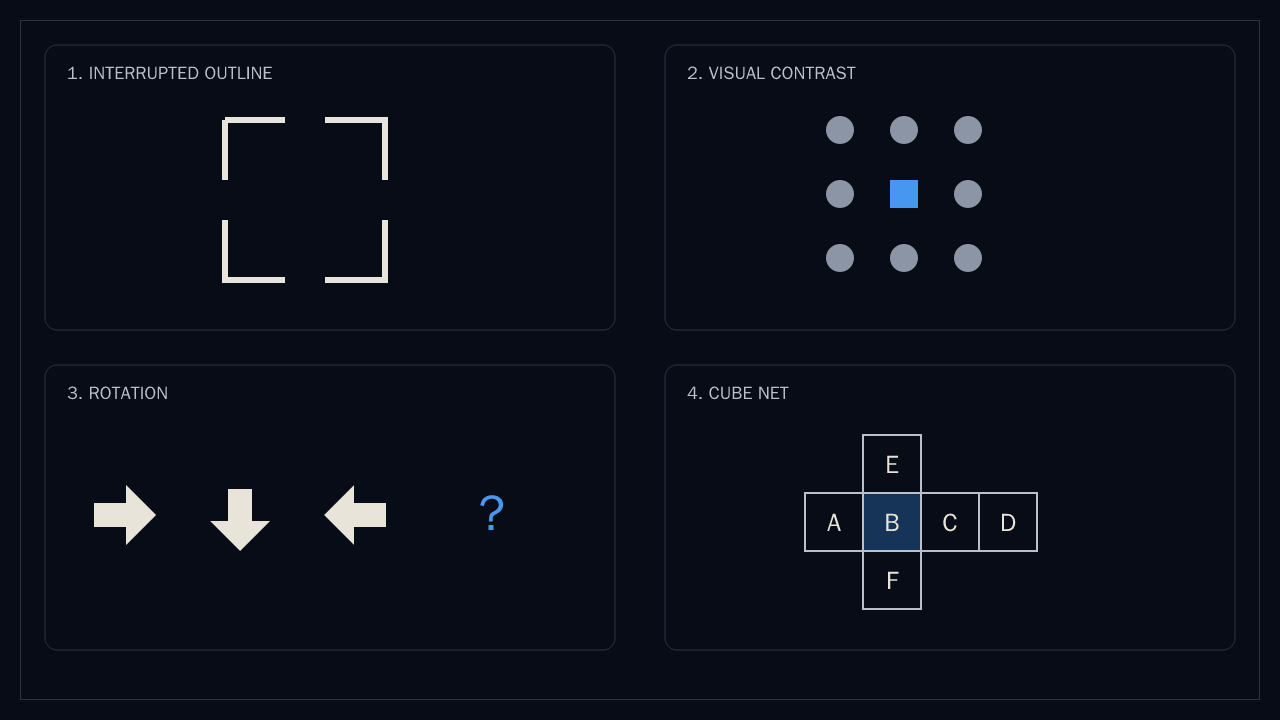
The text below describes the information needed from each panel so you can reason through it without relying on colour alone.
1. Why do you see a complete shape?
Panel 1 shows separate line segments arranged like the sides of a square, with gaps in the outline. Which idea best explains perceiving one complete square?
- A. Proximity, because all nearby objects must form a square
- B. Closure, because perception completes the interrupted outline
- C. Texture, because the lines show a material
- D. Perspective, because the square recedes into space
Answer: B, closure. The arrangement suggests a boundary even where the line is missing. Proximity concerns grouping by nearness; it does not explain the missing parts of the outline as directly.
When reviewing, identify what the question asks you to explain. Recognising a shape and naming the principle behind that perception are different tasks.
2. Which element draws attention?
In Panel 2, eight circles have the same grey appearance. One central element is a blue square. Which design effect does that difference most directly create?
- A. Emphasis through contrast
- B. A change in the physical weight of the page
- C. Linear perspective
- D. A guarantee that every viewer looks at it first
Answer: A. The change in shape and colour makes the element distinct from its neighbours. It can create emphasis through contrast. The word "guarantee" in D is too strong: a design choice can guide attention without controlling every viewer.
The shape difference also means the information does not depend on distinguishing blue from grey.
3. Continue the rotation
Panel 3 shows an arrow pointing right, then down, then left. Each step rotates it 90 degrees clockwise. Which direction comes next?
- A. Right
- B. Down
- C. Left
- D. Up
Answer: D, up. Follow the stated transformation once more. The complete sequence is right, down, left, up, right.
Do not invent a new pattern when the question already gives the rule. If a sequence has no stated transformation, check whether the examples support more than one plausible continuation.
4. Fold the cube net
Panel 4 has four squares in a horizontal row, labelled A, B, C and D. E is directly above B and F is directly below B. When folded into a cube, which face is opposite B?
- A. A
- B. C
- C. D
- D. E
Answer: C, the face labelled D. Treat B as the base. A and C fold up on its left and right. E and F fold up on its other edges. D, attached beyond C, folds over to face B across the cube.
The opposite pairs are B and D, A and C, and E and F. Distinguish the answer-option letter from the face label when recording the response.
5. Scale a square
A square design has side length 4 cm. An enlarged version has side length 6 cm. What is the ratio of the new area to the old area?
- A. 3:2
- B. 9:4
- C. 2:1
- D. 4:9
Answer: B, 9:4. The areas are 36 and 16 square centimetres. Their ratio simplifies to 9:4. The length scale is 3:2; the area scale is its square.
This is an example of proportion and geometry working together. Check whether a question asks about a length, area or volume before using the scale factor.
6. Recognise a material process
A maker starts with a solid block of clay and removes pieces to create a hollow form. Which description matches that operation?
- A. Subtraction of material
- B. Addition of material
- C. Printing a two-dimensional image
- D. Changing only the colour
Answer: A. The stated operation removes material. This does not mean all clay work is subtractive; the answer follows the process described in this question.
Practise that distinction when learning materials. A material can support several techniques, so its name alone does not decide the process.
How to review this set
For each mistake, record whether you missed a definition, a visual relationship, the transformation or a word in the question. Then choose another exercise of that type. Memorising these answer letters will not help with a different diagram.
Pair visual practice with the other published themes, and keep Mathematics and English in the week. Use Maths practice and English practice for those subjects. Our Engineering full papers do not replace an Architecture paper.
Sources and scope
- SADA's guidance defines the themes. These examples teach selected ideas within them.
- The perception reference explains closure and grouping.
- The diagrams, questions and solutions here are original practice material.
Source: SADA Design Aptitude NET Guidelines; OpenStax Psychology 2e on perception; original SailToNUST exercises, checked 24 October 2026