Force and motion in NET tests the equations of motion, Newton's laws, momentum and impulse, projectile motion, and resolving forces for equilibrium. Most questions are one or two lines of algebra once you pick the right equation. Picking it in the first ten seconds is the actual skill.
Key facts
- Physics is 30% of NET-Engineering. At 200 MCQs that is a derived 60 physics questions.
- Our syllabus data estimates about 8 of those come from this chapter, the most of any first-year chapter alongside waves and electricity.
- The chapter covers Newton's laws, momentum, projectile motion, vector resolution of forces, and the conditions for equilibrium.
Source: NUST NET-Engineering composition and the SailToNUST physics syllabus, checked October 2026
What the chapter covers
The syllabus line for this chapter reads: Newton's laws, momentum, projectile motion, vector resolution of forces, and the equilibrium conditions for a body at rest. In practice NET also pulls in the straight-line equations of motion and the lift problem, so treat them as part of the chapter.
The questions split roughly into two types. Some are one-line concept checks ("rocket flight is an example of which law"). The rest are short numericals where the work is choosing the equation, then doing clean arithmetic with g = 10.
Formulas you need
Equations of motion (constant acceleration a)
v = u + at
s = ut + ½at²
v² = u² + 2as

Newton's second law     F = ma            N = kg m s⁻²
Momentum                p = mv            kg m s⁻¹ = N s
Impulse                 J = FΔt = Δp      N s

Projectile on level ground (speed u, angle θ above horizontal)
Time of flight          T = 2u sinθ / g
Maximum height          H = u² sin²θ / (2g)
Range                   R = u² sin2θ / g
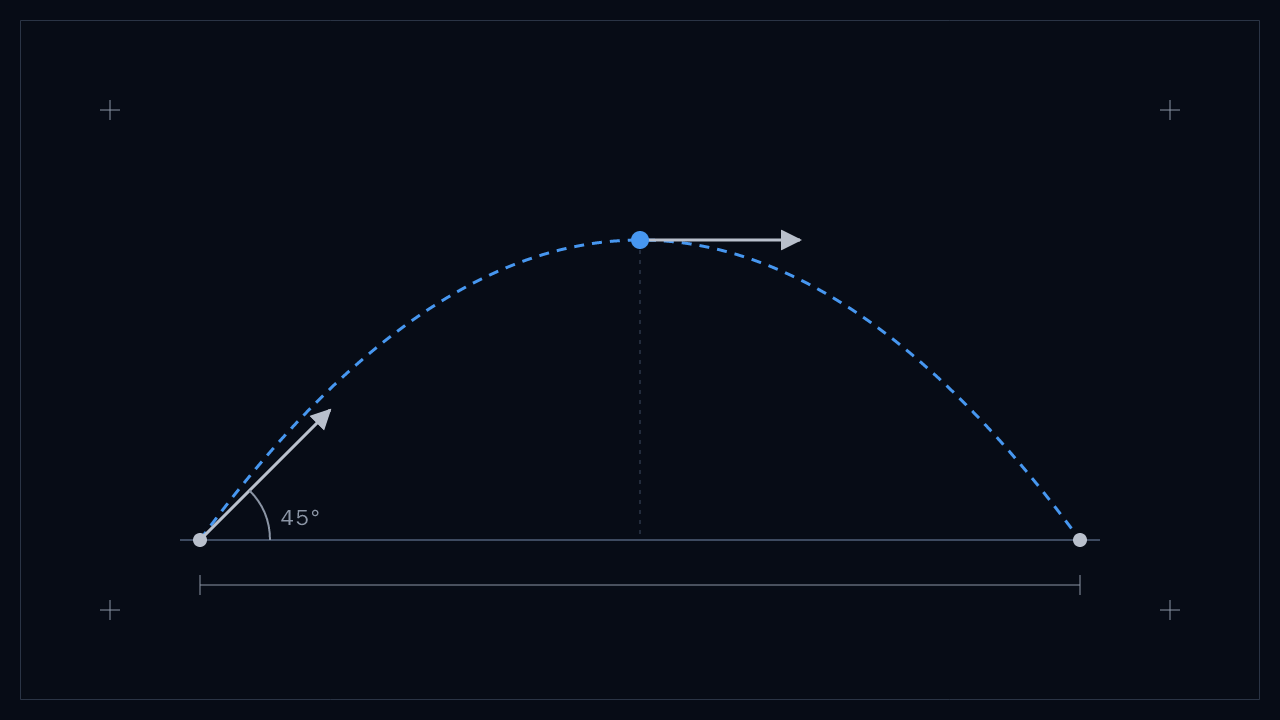
Maximum range           R_max = u² / g   at θ = 45°

Components of a force F at angle θ to the x-axis
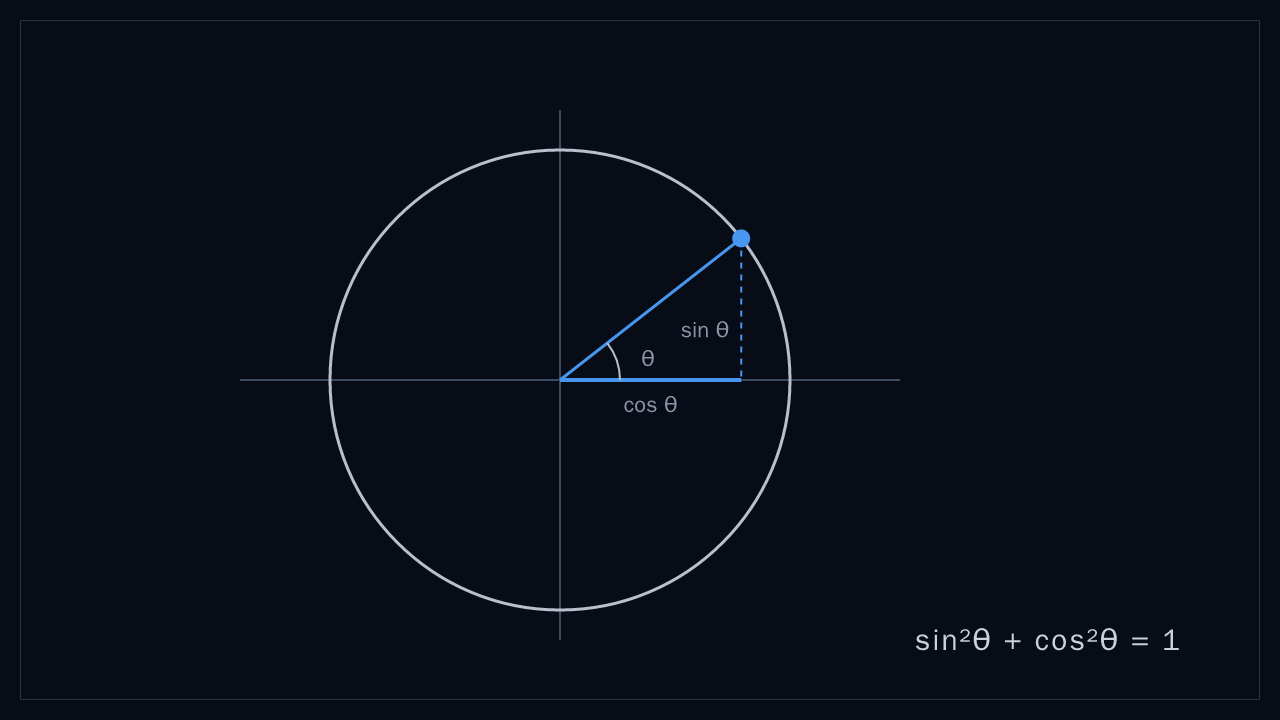
Fx = F cosθ,  Fy = F sinθ,  F = √(Fx² + Fy²)

Equilibrium             ΣF = 0 (first condition)
                        Στ = 0 (second condition)

Apparent weight in a lift (acceleration a)
going up:   R = m(g + a)
going down: R = m(g − a)
Worked MCQs
1. Projectile range. A ball is thrown at 20 m/s at 30° above the horizontal. Taking g = 10 m/s², how far away does it land?
(a) 20 m (b) 34.6 m (c) 40 m (d) 17.3 m
R = u² sin2θ / g = (400 × sin60°) / 10 = 40 × 0.866 = 34.6 m
Answer (b). Option (c) is u²/g, the maximum range at 45°. You land on it if you drop the sine. A ball thrown at 60° with the same speed lands at the same 34.6 m, because 30° and 60° add up to 90°.
2. Packet dropped from a rising balloon. A balloon rising at 12 m/s releases a packet at a height of 65 m. With g = 10 m/s², how long does the packet take to reach the ground?
(a) 5 s (b) 6 s (c) 7 s (d) 8 s
The packet leaves with the balloon's upward velocity of 12 m/s. Take up as positive. The ground is 65 m below.
−65 = 12t − 5t²
5t² − 12t − 65 = 0
t = [12 + √(144 + 1300)] / 10 = (12 + 38) / 10 = 5 s
Answer (a). If you assumed the packet starts from rest you would get √13 s, about 3.6 s, which is not even an option. The question is testing whether you remember that a dropped object keeps the velocity of whatever it was dropped from.
3. Impulse on a rebounding ball. A 0.2 kg ball hits a wall at 10 m/s and bounces straight back at 10 m/s. Contact lasts 0.01 s. What is the average force on the ball?
(a) 0 N (b) 200 N (c) 400 N (d) 20 N
Δp = m(v − u) = 0.2 × (−10 − 10) = −4 N s
F = Δp / Δt = 4 / 0.01 = 400 N
Answer (c). The speed did not change, but the velocity reversed, so the change in momentum is double the initial momentum. Picking (a) or (b) is the usual mistake.
4. Scale reading in a lift. A 60 kg student stands on a scale in a lift that is accelerating downward at 2 m/s². With g = 10 m/s², what does the scale read?
(a) 720 N (b) 600 N (c) 480 N (d) 120 N
R = m(g − a) = 60 × (10 − 2) = 480 N
Answer (c). The scale reads the normal force, not the weight. Downward acceleration reduces it. A lift moving down at constant speed would read 600 N.
5. Resolving a force. A 15 N force acts along the y-axis. Together with a horizontal force, it gives a resultant at 30° to the x-axis. What is the horizontal force?
(a) 20 N (b) 26 N (c) 30 N (d) 21 N
tan30° = Fy / Fx
Fx = 15 / tan30° = 15 / 0.577 = 26 N
Answer (b). Draw the triangle before you choose sin, cos or tan. Most errors here come from putting the 30° at the wrong corner.
Traps that cost marks
- Velocity at the top of a projectile is not zero. Only the vertical part is zero. The horizontal part u cosθ stays. That is why kinetic energy at the top equals KE₀ cos²θ. At 45° the ratio is 1:2. The practice bank asks exactly that.
- Complementary angles give the same range. 15° and 75° land at the same spot. The 75° throw stays in the air longer and goes higher.
- Mass does not change free-fall time. A 1 kg and a 10 kg ball dropped from 80 m both land after 4 s, ignoring air resistance.
- Action and reaction act on different bodies. They never cancel each other. If a question asks why a horse can pull a cart, the answer is about friction from the ground, not about the pair cancelling.
- Torque needs the perpendicular distance. For a pendulum bob at angle θ, the torque about the pivot is mgl sinθ. Some printed answer keys get this wrong, so trust the definition τ = rF sinθ.
Speed tips for the exam
Learn the 5t² table for g = 10: 1 s gives 5 m, 2 s gives 20 m, 3 s gives 45 m, 4 s gives 80 m, 5 s gives 125 m. A "dropped from 80 m" question then takes three seconds to answer, not thirty.
For projectiles, find T first. Height and range follow from it. H is ⅛gT², and R is u cosθ × T. Once you have T, the rest of the question is one line each.
If a question gives no value of g, look at the options. If they are round numbers, g = 10 was intended. If they look like 5.97 s or 4.68 s, the setter used 9.8.
For the full set of physics formulas on one page, see the physics formula sheet. The next chapter in the sequence is work, energy and power, which reuses the same equations of motion.
FAQ
Is force and motion important for NET?
Yes. Physics is 30% of NET-Engineering, and our syllabus estimate puts this chapter at about 8 of the derived 60 physics MCQs. It also feeds into work, energy and circular motion, so weak basics here hurt you in three chapters.
Should I use g = 9.8 or g = 10 in NET?
Use whatever the question states. If it states nothing, check the options: round answers mean 10, awkward decimals mean 9.8.
Which projectile formulas should I memorise for NET?
Time of flight, maximum height and range for level ground, plus the fact that range is maximum at 45°. Everything else follows from the horizontal and vertical components.
How do I get faster at physics numericals?
Do timed sets from one chapter until the equation choice is automatic, then mix chapters. The NET physics guide covers how to split your physics time.