This is the NET physics formula sheet, chapter by chapter, from measurements to nuclear physics, with the constants you need to carry in your head. Physics is 30% of NET-Engineering, and most of its numericals need one of these formulas plus a ratio, so knowing them cold is most of the work.
Key facts
- Physics is 30% of NET-Engineering, about 60 of 200 questions (derived; NUST publishes percentages only)
- The syllabus follows HSSC Part-I and Part-II physics
- SI units throughout. Convert cm, g and minutes before you substitute
Source: NUST, Subjects included in NET with weightings, checked October 2026
Constants and measurements
Constants
g  = 9.8 m s⁻²  (use 10 when the options are rounded)
G  = 6.67 × 10⁻¹¹ N m² kg⁻²
c  = 3 × 10⁸ m s⁻¹
e  = 1.6 × 10⁻¹⁹ C          1 eV = 1.6 × 10⁻¹⁹ J
mₑ = 9.11 × 10⁻³¹ kg        mₚ ≈ 1.67 × 10⁻²⁷ kg
h  = 6.63 × 10⁻³⁴ J s
k  = 1/(4πε₀) = 9 × 10⁹ N m² C⁻²        ε₀ = 8.85 × 10⁻¹² C² N⁻¹ m⁻²
μ₀ = 4π × 10⁻⁷ T m A⁻¹
Nₐ = 6.02 × 10²³ mol⁻¹      R = 8.314 J mol⁻¹ K⁻¹      k_B = 1.38 × 10⁻²³ J K⁻¹
1 u = 1.66 × 10⁻²⁷ kg ≈ 931 MeV
Force MLT⁻²     Energy, work ML²T⁻²     Power ML²T⁻³     Momentum MLT⁻¹
Pressure, stress ML⁻¹T⁻²     Viscosity η ML⁻¹T⁻¹     G M⁻¹L³T⁻²     h ML²T⁻¹
Uncertainty:
  adding or subtracting  → add absolute uncertainties
  multiplying or dividing → add percentage uncertainties
  xⁿ → n × percentage uncertainty of x
Mechanics
v = u + at        s = ut + ½at²        v² = u² + 2as        s = ½(u + v)t
Free fall from rest:  h = ½gt²,  v = gt
Projectile, launch speed u at angle θ:
  time of flight T = 2u sin θ / g
  maximum height H = u² sin²θ / 2g
  range R = u² sin 2θ / g        maximum range u²/g at 45°
F = ma        p = mv        F = Δp/Δt        impulse FΔt = Δp
Friction f = μN        block sliding down an incline: a = g(sin θ − μ cos θ)
Lift: apparent weight m(g + a) going up with acceleration a, m(g − a) going down
Elastic collision, m₁ at u₁ hits m₂ at rest:
  v₁ = (m₁ − m₂)u₁/(m₁ + m₂)        v₂ = 2m₁u₁/(m₁ + m₂)
Equilibrium:  ΣF = 0 (first condition)    Στ = 0 (second condition)
Torque τ = rF sin θ
W = Fd cos θ        KE = ½mv² = p²/2m        PE = mgh
Work-energy theorem:  W_net = ΔKE
P = W/t = Fv        1 kWh = 3.6 × 10⁶ J
Efficiency = useful output / input
Gravitational PE far from Earth:  U = −GMm/r
Escape velocity  vₑ = √(2GM/R) = √(2gR) ≈ 11.2 km s⁻¹ for Earth
Circular and rotational motion
θ = s/r (radians)    v = rω    ω = 2π/T = 2πf    aₜ = rα
Centripetal:  a = v²/r = rω²        F = mv²/r
Angular kinematics:  ω_f = ω_i + αt    θ = ω_i t + ½αt²    ω_f² = ω_i² + 2αθ
Moment of inertia:  hoop MR²    disc ½MR²    solid sphere (2/5)MR²    rod about centre (1/12)ML²
L = Iω        τ = Iα        rotational KE = ½Iω²
Rolling body:  total KE = ½mv² + ½Iω²
Gravitation:  F = Gm₁m₂/r²        g = GM/R²
Orbital speed v = √(GM/r)        near Earth's surface v = √(gR)
Solids, fluids and heat
Stress = F/A        Strain = ΔL/L        Young's modulus Y = (F/A)/(ΔL/L)
Hooke's law F = kx        Elastic PE = ½kx² = ½F·ΔL
Pressure P = F/A        in a fluid P = ρgh
Continuity:  A₁v₁ = A₂v₂
Bernoulli:  P + ½ρv² + ρgh = constant
Torricelli:  v = √(2gh)
Stokes drag:  F = 6πηrv
Terminal velocity (ignoring buoyancy):  v_t = 2r²ρg / 9η
T(K) = T(°C) + 273        T(°F) = (9/5)T(°C) + 32
Q = mcΔT        Q = mL (change of state)
ΔL = αLΔT        ΔV = βVΔT,  β ≈ 3α
Ideal gas:  PV = nRT = Nk_BT
Kinetic theory:  P = ⅓ρv_rms²    average KE per molecule = (3/2)k_BT    v_rms = √(3RT/M)
First law:  Q = ΔU + W   (W = work done by the gas;  W = PΔV at constant pressure)
  isothermal ΔU = 0    adiabatic Q = 0    constant volume W = 0
Cₚ − Cᵥ = R (molar)        γ = Cₚ/Cᵥ
Heat engine efficiency = W/Q_h = 1 − Q_c/Q_h
Carnot efficiency = 1 − T_c/T_h   (kelvin)
Entropy change ΔS = Q/T
Waves, oscillations and optics
SHM:  a = −ω²x        x = x₀ sin ωt
  v = ω√(x₀² − x²)    v_max = ωx₀    a_max = ω²x₀
  total energy = ½kx₀²        KE at x = ½k(x₀² − x²)
Spring-mass  T = 2π√(m/k)        Simple pendulum  T = 2π√(l/g)
Waves:  v = fλ        f = 1/T
String under tension T with mass per length μ:  v = √(T/μ)
Sound in a gas:  v = √(γP/ρ),  v ∝ √T(K);  in air about 0.61 m s⁻¹ faster per °C
String fixed at both ends:  fₙ = nv/2L,  n = 1, 2, 3 ...
Pipe open at both ends:  fₙ = nv/2L,  all harmonics
Pipe closed at one end:  fₙ = nv/4L,  n = 1, 3, 5 ... (odd only)
Beats:  f_beat = |f₁ − f₂|
Doppler:  f' = f(v + v_o)/(v − v_s)  when observer and source approach each other
          f' = f(v − v_o)/(v + v_s)  when they move apart
Refractive index n = c/v
Young's double slit:  fringe spacing Δy = λL/d
  bright fringe: path difference mλ        dark fringe: (m + ½)λ
Michelson interferometer:  moving the mirror by λ/2 shifts one whole fringe
Diffraction grating:  d sin θ = mλ,  d = 1/(lines per metre)
Single slit minima:  a sin θ = mλ
X-ray (Bragg) diffraction:  2d sin θ = mλ
Malus's law:  I = I₀ cos²θ        Brewster angle:  tan θ_B = n
Electricity and magnetism
Electrostatics and current electricity
Coulomb:  F = kq₁q₂/r²        in a medium F is divided by εᵣ
Field E = F/q = kq/r²        Potential V = kq/r        Work W = qV
Uniform field between plates:  E = V/d
Gauss:  flux Φ = q/ε₀
Capacitor:  C = Q/V        parallel plates C = ε₀εᵣA/d
  energy U = ½CV² = Q²/2C = ½QV
  series 1/C = 1/C₁ + 1/C₂        parallel C = C₁ + C₂
  RC circuit time constant τ = RC
Current I = Q/t = nAvq
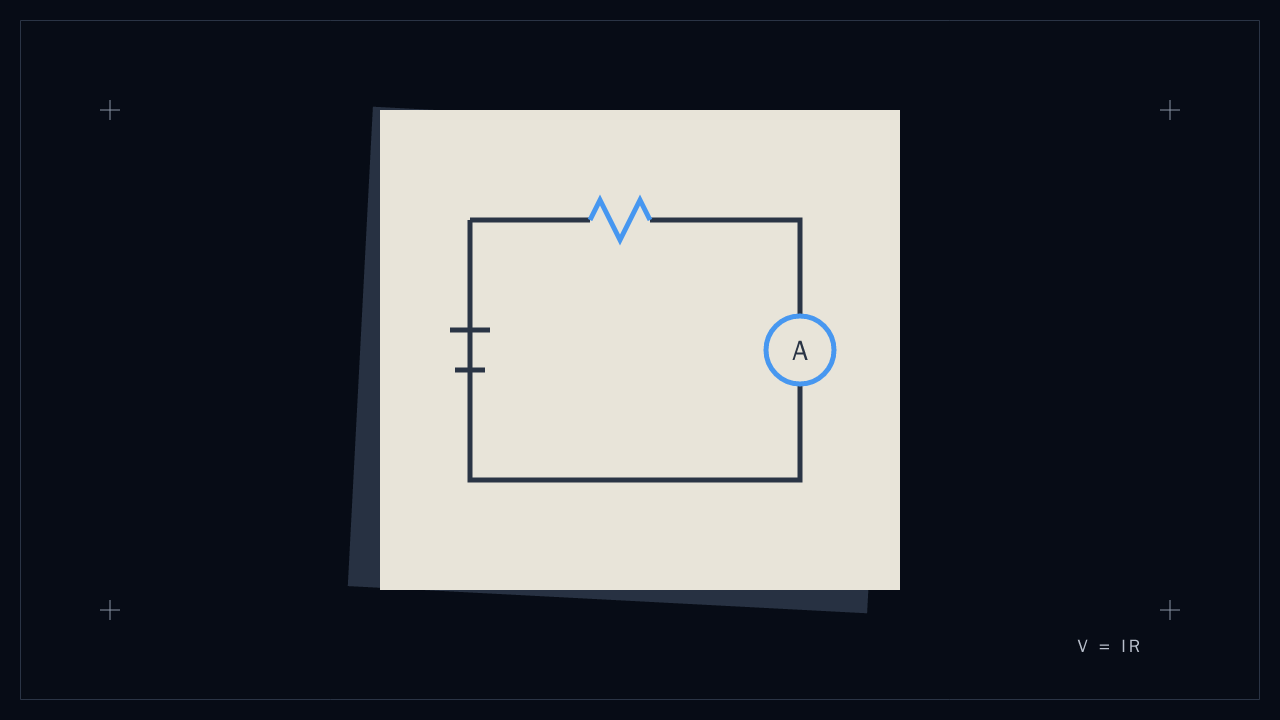
Ohm's law V = IR        R = ρL/A        R_T = R₀(1 + αΔT)
Series R = R₁ + R₂        Parallel 1/R = 1/R₁ + 1/R₂
Power P = VI = I²R = V²/R        Energy W = VIt
Terminal voltage V = ε − Ir        maximum power to load when R = r
Kirchhoff:  ΣI = 0 at a junction        Σε = ΣIR round a loop
Wheatstone bridge balanced:  P/Q = R/S
Potentiometer:  ε₁/ε₂ = l₁/l₂
Force on a wire F = BIL sin θ        Force on a charge F = qvB sin θ
Radius of circular path r = mv/qB
Long straight wire B = μ₀I/2πr        Solenoid B = μ₀nI  (n = turns per metre)
Torque on a coil τ = BINA cos α  (α = angle between coil plane and field)
Flux Φ = BA cos θ
Faraday:  ε = −NΔΦ/Δt        Motional emf ε = vBL
Self-induction ε = −LΔI/Δt        Energy in an inductor U = ½LI²
Mutual induction ε₂ = −MΔI₁/Δt
AC generator  ε = NABω sin ωt
Ideal transformer  Vₛ/Vₚ = Nₛ/Nₚ = Iₚ/Iₛ
Galvanometer to ammeter: shunt Rₛ = I_gR_g/(I − I_g)
Galvanometer to voltmeter: series R = V/I_g − R_g
V_rms = V₀/√2        I_rms = I₀/√2
X_L = ωL = 2πfL        X_C = 1/ωC = 1/(2πfC)
Series RLC:  Z = √(R² + (X_L − X_C)²)        tan φ = (X_L − X_C)/R
Power P = V_rms I_rms cos φ        power factor cos φ = R/Z
Resonance f₀ = 1/(2π√(LC))
Phase of current: in phase in R, lags 90° in pure L, leads 90° in pure C
Modern physics
γ = 1/√(1 − v²/c²)
Time dilation t = γt₀        Length contraction L = L₀/γ        Mass m = γm₀
E = mc²
Photon:  E = hf = hc/λ        p = h/λ
Photoelectric:  hf = φ + KE_max        KE_max = eV₀        threshold f₀ = φ/h
Compton shift:  Δλ = (h/m₀c)(1 − cos θ),  largest at θ = 180°
de Broglie:  λ = h/p = h/mv        electron through V volts: λ = h/√(2meV)
Uncertainty:  Δx·Δp ≥ ħ/2  (many FSc books write Δx·Δp ≈ h)
Bohr hydrogen:  rₙ = n²r₁,  r₁ = 0.053 nm        Eₙ = −13.6/n² eV
Emitted photon:  hf = E_upper − E_lower
Rydberg:  1/λ = R_H(1/p² − 1/n²),  R_H = 1.097 × 10⁷ m⁻¹
Wien:  λ_max·T = 2.9 × 10⁻³ m K        Stefan:  E = σT⁴
Pair production needs at least 1.02 MeV
Mass number A = Z + N
Mass defect Δm = (Zmₚ + Nmₙ) − M_nucleus        Binding energy = Δm·c²  (1 u → 931 MeV)
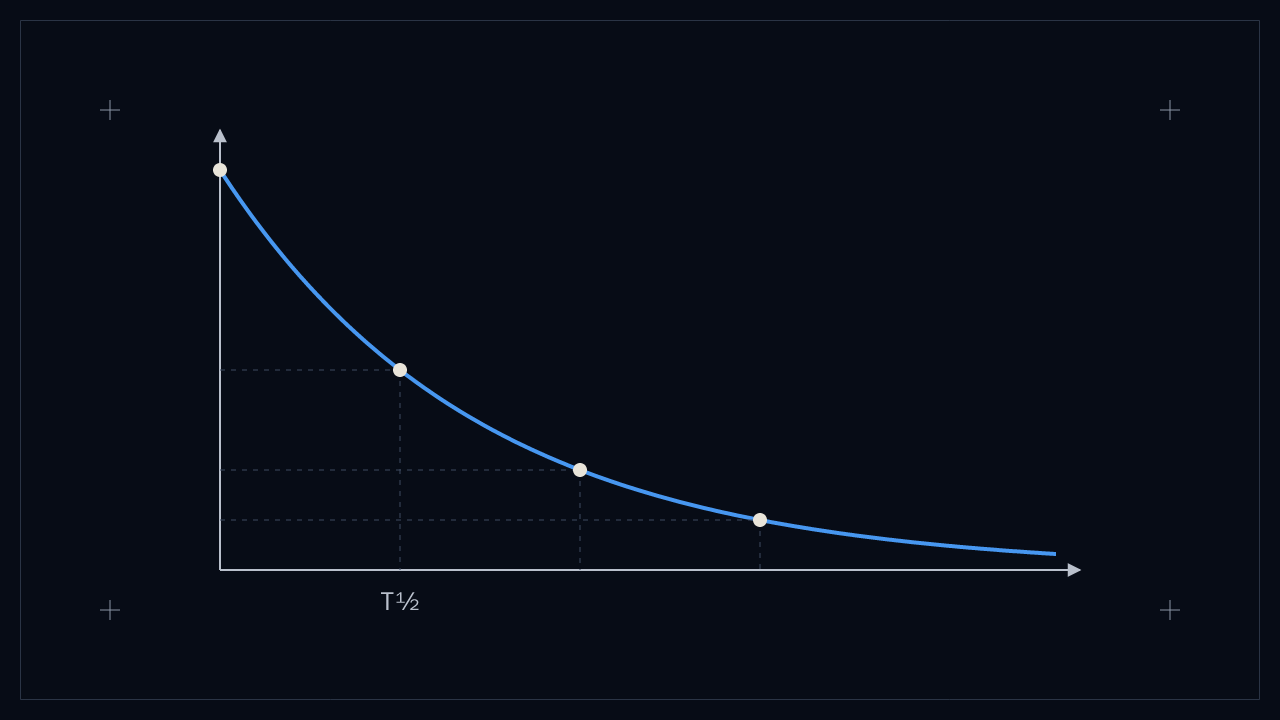
Decay:  N = N₀e^(−λt) = N₀(½)^(t/T½)        T½ = 0.693/λ        Activity A = λN
α decay:  A − 4, Z − 2        β⁻ decay:  A same, Z + 1        γ:  no change in A or Z
One U-235 fission releases about 200 MeV
How to use this sheet
Reading it is not enough. Cover one block, write out what you remember, then check. Every formula you miss goes on a card you review daily.
Next, learn which ratio each formula hides. If F = kq₁q₂/r², doubling both charges and halving the distance makes the force 16 times larger. If U = ½LI², a current 100 times larger stores 10,000 times the energy. Most NET physics numericals are these ratio moves, and the NET physics guide has more of them.
Maths has its own sheet: the NET maths formula sheet.
FAQ
Which physics formulas are most important for NET?
The equations of motion, Newton's laws, work and energy, circular motion, Coulomb's and Ohm's laws, capacitance, Faraday's law, and the photon and Bohr formulas. These cover the mechanics, electricity and modern physics chapters.
Should I use g = 9.8 or 10 in NET?
Use whatever the question gives. If it gives nothing and the options are rounded, 10 m/s² is usually what the setter used, so check both if two options are close.
Do I need to memorise physical constants for NET?
Learn the short list at the top of this page. Questions often give the constant, but knowing it saves you a reread and catches wrong-power options.