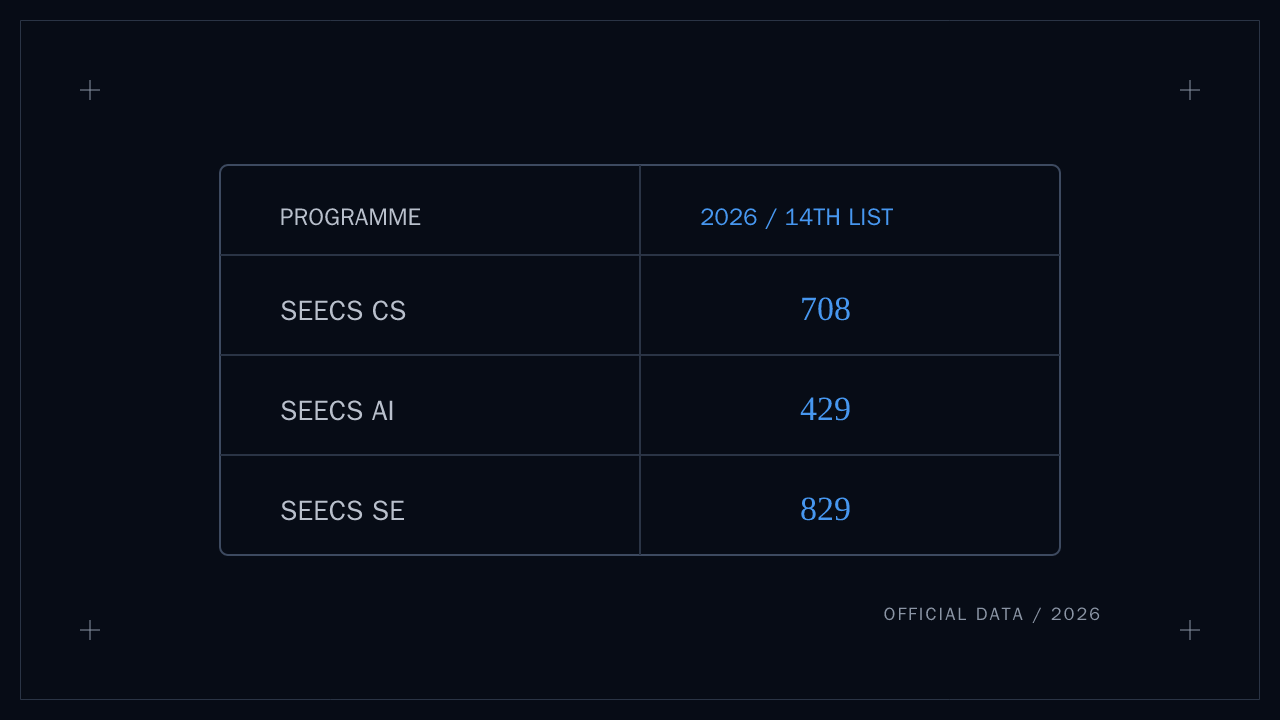
The NET marks you need depend on your FSc and Matric results and the aggregate you want to reach. NUST's UG 2026 14th list gives closing positions, including SEECS CS 708, AI 429 and SE 829. Those ranks cannot supply the closing aggregates or NET marks, so the score targets below remain worked examples.
Formula and limits
- NET contributes 75%, HSSC 15% and SSC 10% for the standard school-results calculation.
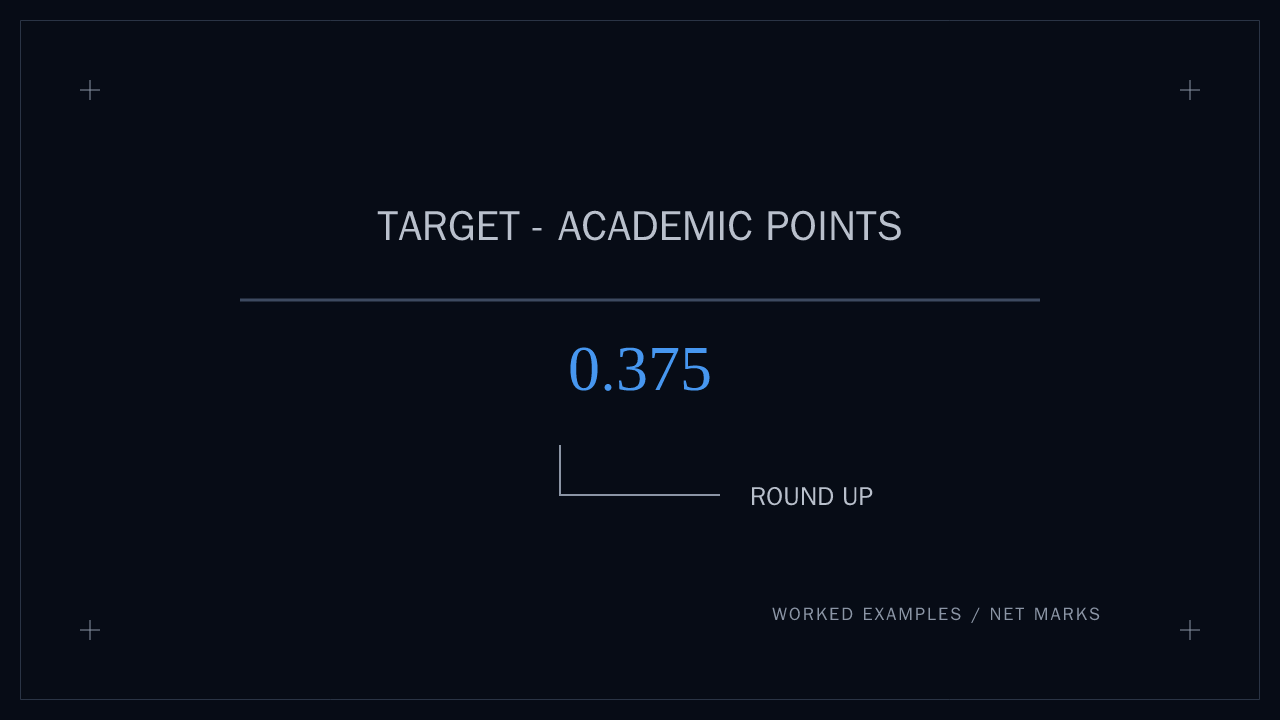
- Each NET mark adds 0.375 aggregate points.
- Round a fractional required score up to the next whole mark.
- These tables do not predict admission to any named programme.
Source: NUST merit criteria; NUST Admissions Directorate, 14th merit selection list, UG 2026; checked November 2026; calculations follow src/lib/net-facts.ts
Real programme positions do not give NET score cutoffs
| Programme | Institute | 2026 14th-list closing position |
|---|---|---|
| BS Computer Science | SEECS | 708 |
| BS Artificial Intelligence | SEECS | 429 |
| BE Software Engineering | SEECS | 829 |
| BS Data Science | SEECS | 843 |
| BBA | NBS | 722 |
| BS Accounting and Finance | NBS | 467 |
Source: NUST Admissions Directorate, 14th merit selection list, UG 2026. Our complete 2026 closing-merit tables give the remaining programmes and campuses. A position is a rank inside a merit pool, not a percentage or a score out of 200.
The record does not supply the selected candidates' aggregates or academic marks. We therefore cannot convert these positions into programme-specific NET requirements. Use the calculations below to plan a score from your own results, while keeping the historical rank in a separate column.
Calculate the score from percentages
Use the percentage for the HSSC result NUST accepts in your application. If you enter raw marks in the calculator, enter their actual total too. Do not mix a Part-I numerator with a completed-FSc denominator.
Academic contribution = FSc% * 0.15 + Matric% * 0.10
NET needed = (target aggregate - academic contribution) / 0.375
Required whole score = round up NET needed
For FSc 80% and Matric 90%, the academic contribution is 12 + 9 = 21 points. An illustrative 80% aggregate therefore requires 59 / 0.375 = 157.33 marks. Round up to 158. Substituting back gives 158 * 0.375 + 21 = 80.25%.
Rounding to 157 would give 79.875%, below the target. Keep the unrounded calculation until the last step, even if a displayed percentage rounds to 80.00.
NET marks needed across FSc and Matric combinations
Every cell is the smallest whole NET score that reaches the column's illustrative target. Scores are out of 200. None of the column headings represents an official NUST 2026 closing aggregate.
| FSc | Matric | Academic points | Target 70% | Target 75% | Target 80% | Target 85% |
|---|---|---|---|---|---|---|
| 60% | 60% | 15.00 | 147 | 160 | 174 | 187 |
| 70% | 80% | 18.50 | 138 | 151 | 164 | 178 |
| 75% | 85% | 19.75 | 134 | 148 | 161 | 174 |
| 80% | 80% | 20.00 | 134 | 147 | 160 | 174 |
| 80% | 90% | 21.00 | 131 | 144 | 158 | 171 |
| 85% | 90% | 21.75 | 129 | 142 | 156 | 169 |
| 90% | 90% | 22.50 | 127 | 140 | 154 | 167 |
| 90% | 95% | 23.00 | 126 | 139 | 152 | 166 |
| 95% | 95% | 23.75 | 124 | 137 | 150 | 164 |
Read across your nearest profile to understand the scale, then calculate your exact result. Five FSc percentage points change the academic contribution by 0.75 points. That equals two NET marks. Ten Matric percentage points contribute one aggregate point, equivalent to about 2.67 NET marks.
Those comparisons explain why two applicants asking for the same programme can need different NET scores. They do not let anyone ignore the eligibility floor of 60% in both SSC and HSSC.
Apply the table to a programme shortlist
Start with NUST's programme list and check that your subjects meet each degree's eligibility rules. Next, select a planning aggregate and write it beside the programme as your own target. Keep a separate column for the matching programme and institute position in the 2026 record above.
For example, a Computing applicant with FSc 85% and Matric 90% might choose 80% as a practice target. The table returns 156. This is arithmetic for that applicant, not a claim that SEECS CS closed at 80% or that 156 secures admission.
Use the merit-list guide when you arrange preferences. Keep the programme, school, year and selection stage attached to any historical figure you use.
Check special cases before copying a row
For an A-Level final-year applicant using the O-Level-only calculation, the stored rule uses NET 75% and O-Level equivalence 25%. The FSc/Matric table does not represent that case. Use the calculator's matching option and the accepted IBCC equivalence.
If your calculation exceeds 200 marks, the target cannot be reached with those academic percentages under this formula. If your mock score sits below the target, the difference tells you what to work toward. It does not prove that a programme is out of reach before you sit NET.
How to prepare for your programme's NET paper on SailToNUST
Check the paper syllabus first. Engineering and Computing candidates can use our Engineering full papers for timed practice. Review wrong answers, practise the chapters behind them and use the simulator to rehearse the test controls.