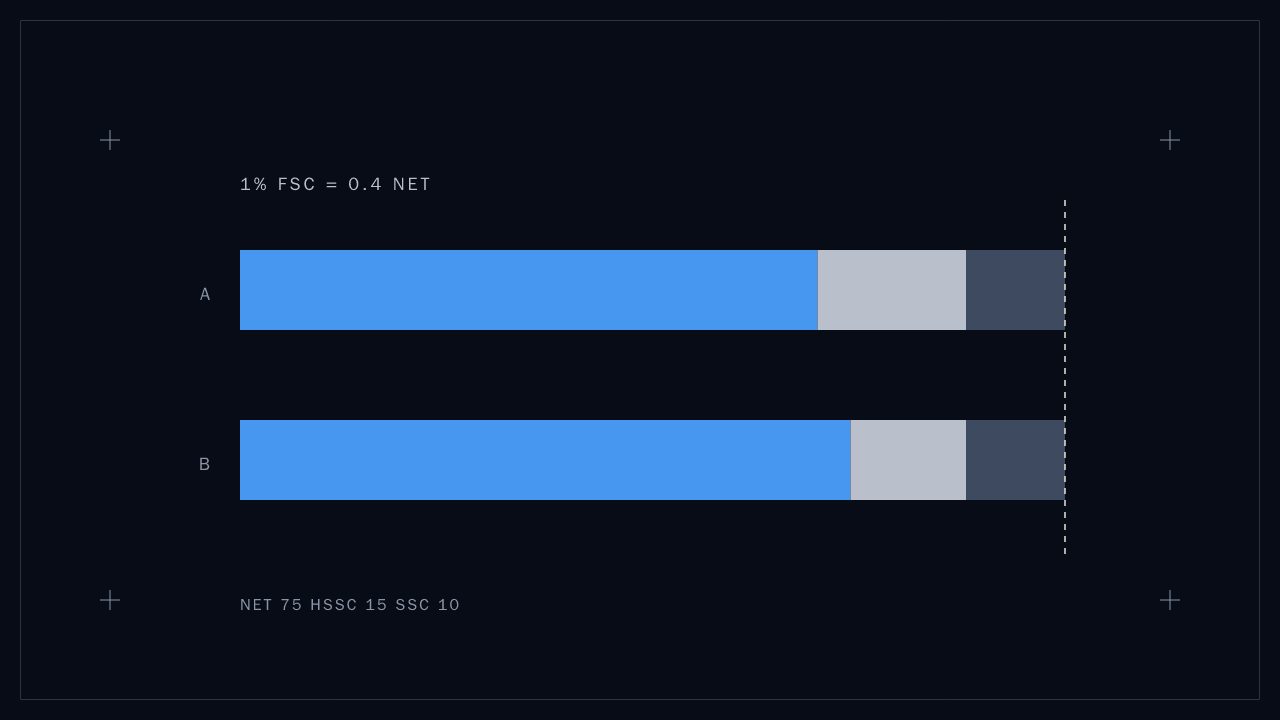
Yes, as long as you clear 60% in both matric and FSc. NET is 75% of NUST's aggregate and HSSC only 15%, so every 1% you lost in FSc costs 0.4 NET marks to win back: a 10-point weaker FSc needs 4 more NET marks. Below 60%, no NET score helps, because you are not eligible.
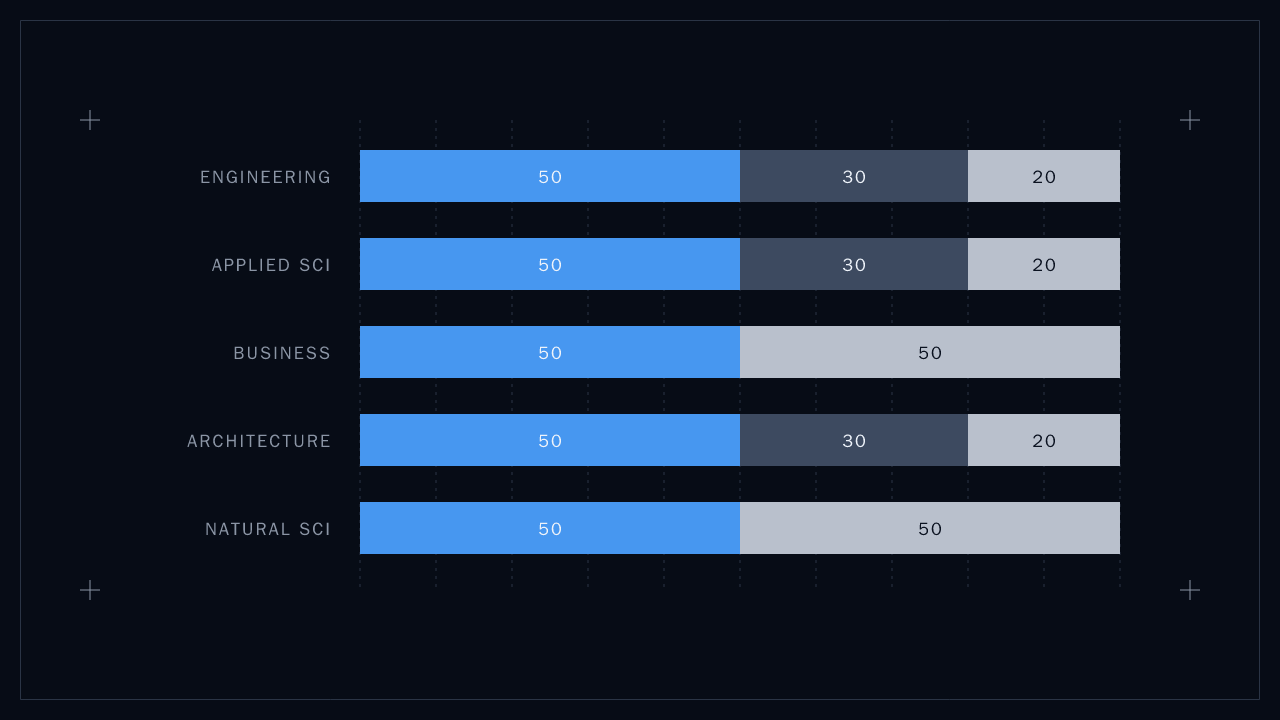
The formula is the same for every programme admitted on NET, from Engineering to BBA. The arithmetic below works for all of them.
Key facts
- Merit on NET basis: NET 75%, HSSC (Part-1) or HSSC 15%, SSC 10%
- Same weights for every NET-basis programme. Programmes differ only in which NET paper counts
- A-Level final-year candidates: O-Level equivalence carries 25%
- Minimum 60% each in SSC and HSSC. Below that, a candidate is ineligible
- You can apply with under 60% in FSc Part-1, but need 60% in the full FSc result when you join
Source: NUST merit generation criteria, eligibility criteria, ineligibility criteria and UG admissions FAQ pages, checked October 2026
Does the formula change by programme?
No. NUST's merit criteria page gives one general formula, NET 75%, SSC 10%, HSSC 15%. Its programme-wise table then lists which NET paper each programme uses and how the score is picked, usually "Best score". For BS Bioinformatics, Food Science and Chemistry it takes the best score even if you sat both NET-Engineering and NET-Applied Sciences. None of the rows change the weights.
So a BBA candidate and an Electrical Engineering candidate face the same trade between NET and FSc. Only the paper differs.
The exchange rate
Turn each component into aggregate points:
aggregate = NET/200 x 75  +  HSSC% x 0.15  +  SSC% x 0.10

1 NET mark     = 75/200  = 0.375 aggregate points
1% of HSSC     = 0.15 aggregate points  = 0.40 NET marks
1% of SSC      = 0.10 aggregate points  = 0.27 NET marks
1% of O-Level  = 0.25 aggregate points  = 0.67 NET marks  (A-Level final year)
That gives a simple table for FSc students:
| FSc gap to a rival | NET marks needed to close it |
|---|---|
| 5% | 2 |
| 10% | 4 |
| 20% | 8 |
| 30% | 12 |
On a 200-question paper, 4 marks is 4 extra correct answers. That is why NUST's merit list moves on NET far more than on school marks.
Worked examples
Take a student with 90% in both matric and FSc who scores 140 in NET:
Student A:  140/200 x 75 = 52.50
            90 x 0.15    = 13.50
            90 x 0.10    =  9.00
            aggregate    = 75.00
Student B has the same matric but only 70% in FSc. What NET score ties with A?
Student B:  70 x 0.15 = 10.50
            90 x 0.10 =  9.00
            NET points needed = 75.00 - 19.50 = 55.50
            NET needed = 55.50 / 0.375 = 148
Twenty points of FSc cost 8 NET marks. B ties with A at 148.
Student C is near the floor on both: 62% in FSc and 65% in matric.
Student C:  62 x 0.15 = 9.30
            65 x 0.10 = 6.50
            NET points needed = 75.00 - 15.80 = 59.20
            NET needed = 59.20 / 0.375 = 157.9, so 158
C needs 18 more NET marks than A to reach the same aggregate. That is a real gap, but on a paper where one extra correct answer in every eleven questions closes it.
Where it stops working: the 60% floor
NUST's ineligibility criteria list "less than 60% marks in SSC and HSSC". The eligibility page asks for a minimum 60% each in SSC and HSSC. A 190 in NET does not change that.
There is one detail most students miss. NUST's FAQ says a candidate with less than 60% in FSc Part-1 can still apply, and the Part-1 marks are used for merit. But on joining, the candidate must have 60% or more in the complete FSc result. So:
- Part-1 below 60%: you can sit NET and appear on the merit list.
- Full FSc below 60%: the admission cannot be confirmed, whatever your NET score.
If your Part-1 is weak, your Part-2 board exams decide whether your NET score counts at all. Don't let NET preparation crowd them out.
What closing merit tells you
Nothing reliable, yet. NUST says it posts the previous session's closing merit for guidance, but we found no table on its site in October 2026. The closing merit post explains how to estimate a target band from admitted seniors instead.
Once you have a target aggregate, work backwards with your own marks:
NET needed = (target - HSSC% x 0.15 - SSC% x 0.10) / 0.375
Or put the numbers into the aggregate calculator, which runs the same formula with both the Part-1 (out of 550) and full FSc (out of 1100) versions.
Compared with other universities
NUST is unusually kind to a weak FSc. At FAST, HSSC is 40% of computing merit, so each lost FSc percent costs more than twice as much as at NUST. The NUST vs FAST post has that comparison worked out. If your FSc went badly, NUST is the better bet, provided your NET preparation is strong.
For how the three parts combine in detail, read how the NET merit formula works. For turning an aggregate into a score target, read what NET score do you need.
FAQ
Can I get into NUST with 65% in FSc?
You are eligible, since NUST's floor is 60% in both SSC and HSSC. You will need a higher NET score than a student with 85% in FSc: about 8 marks more to make up the 20-point gap.
How many NET marks equal 1% of FSc?
0.4 NET marks. One percent of HSSC is worth 0.15 aggregate points, and one NET mark is worth 0.375.
Can a high NET score get me in with 58% in FSc?
No. NUST lists under 60% in SSC or HSSC as ineligible. You can apply on a Part-1 result below 60%, but you need 60% in the full FSc to join.
Is the merit formula different for BBA or computer science?
No. Every programme admitted on NET uses NET 75%, HSSC 15% and SSC 10%. Only the NET paper changes.
Does matric count more than FSc at NUST?
No. SSC is 10% and HSSC is 15%. For A-Level final-year candidates, O-Level equivalence carries 25% instead.