A first-year NUST routine has to fit lectures, labs or studios, coursework and travel before you add societies or sport. NUST's undergraduate handbook sets attendance and grading rules, but your school issues the actual timetable; the week below is a planning example, not a university timetable.
Key facts
- The handbook requires at least 75% attendance in each course for final-exam eligibility.
- A theory credit hour generally means one weekly contact hour; a lab credit generally means three.
- The handbook describes relative grading and an XF grade for attendance shortage.
- Its graduation CGPA floor is 2.00, with 2.50 for specified business and social-science programmes.
Source: NUST Undergraduate Student Handbook dated 7 November 2023, pages 17 to 24; checked November 2026
Build the week from your school timetable
Use your own section's room codes and sessions. A friend in another programme cannot tell you which days your labs occupy. Read course outlines alongside the timetable so you can distinguish weekly contact time from work due outside class.
The official undergraduate handbook, pages 23 to 24, explains the credit-to-contact relationship. Theory generally uses one contact hour per credit each week. Studio uses two; lab work uses three. Thus a lab credit can occupy a longer session than a theory credit.
These definitions explain workload; they do not assign your first class to a particular hour. Ask the school about any discrepancy between its timetable and your registered courses. The after-selection guide covers checking school messages and Qalam details before classes.
An illustrative first-year week
The academic structure below comes from the handbook's lectures, labs, quizzes, assignments and examinations. The allocation to days is our suggested routine. Move each item around the sessions your school actually schedules.
| Day | Keep fixed | Use a gap for | Before ending the day |
|---|---|---|---|
| Monday | Registered lectures and any lab | Check course outlines and deadlines | List the week's submissions |
| Tuesday | Scheduled teaching | Work on the next assignment | Write down questions for the instructor |
| Wednesday | Scheduled teaching and lab preparation | Library work or a group task | Check the attendance record |
| Thursday | Scheduled teaching | A society or sports session if it fits | Finish the nearest submission |
| Friday | Your published sessions | Review the week's difficult topics | Plan travel around the next teaching day |
| Weekend | Any separately notified requirement | Catch up, rest and prepare | Check messages for timetable changes |
This is not a claim that every NUST programme has Friday free, an identical weekend or the same daily finish time. Keep the notified academic sessions first. Day scholars should allow for their commute; hostellites still need time to move between buildings.
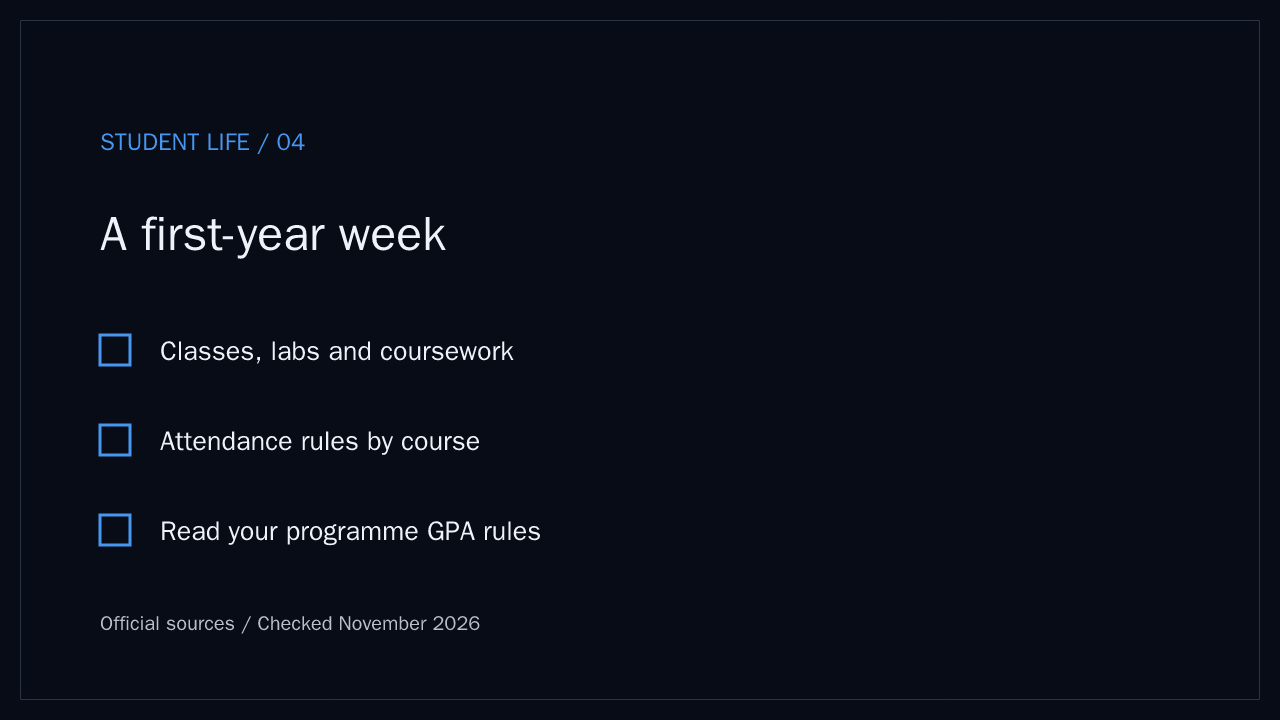
Attendance applies course by course
The handbook's attendance rule says a student below 75% in a particular course cannot sit its end-semester examination. Pages 24 to 25 describe XF for attendance shortage and course repetition. Strong attendance in another subject does not repair that record.
For an arithmetic example, 75% of 40 counted sessions is 30. That is an illustration, not permission to miss ten sessions: your course may count hours or components differently, and its final session total may change. Ask how the instructor records lectures and labs.
Check errors early. Keep evidence if you attended but the record says otherwise, and contact the course team. If illness affects attendance, use the school's documented process promptly. Do not assume that sending a message automatically changes the percentage.
Read GPA rules for your programme
Pages 22 to 23 of the handbook list A at 4.00, B+ at 3.50, B at 3.00, C+ at 2.50 and C at 2.00. They describe relative grading. Don't import a school-board percentage-to-grade chart and assume it sets your NUST letter grade.
The handbook states a minimum graduation CGPA of 2.00, and 2.50 for BBA, BS Economics, BS Public Administration, BS Mass Communication, BS Accounting and Finance, and BS Psychology. Those are the programmes named in that edition. A graduation floor does not explain every probation, progression or withdrawal rule.
This source dates from 7 November 2023. Ask your school for the regulations and amendments applying to your intake, especially if your programme is newer. The student-handbooks download page is the official starting point. I could not verify a later consolidated undergraduate edition for this guide.
Leave space for the rest of campus life
Pick an activity after seeing the real timetable. The societies guide explains how to find current recruitment, and the sports guide covers membership checks. Neither activity should depend on regularly missing a registered session.
Use the orientation guide for arrival week. Orientation events do not describe a normal teaching week. For accommodation and mess arrangements, read the hostel guide and your own residence instructions.
Before joining, practise the same cycle with NET: attempt, review, repair, then attempt again. Choose the next chapter from errors rather than spending every day on the subject you already like.