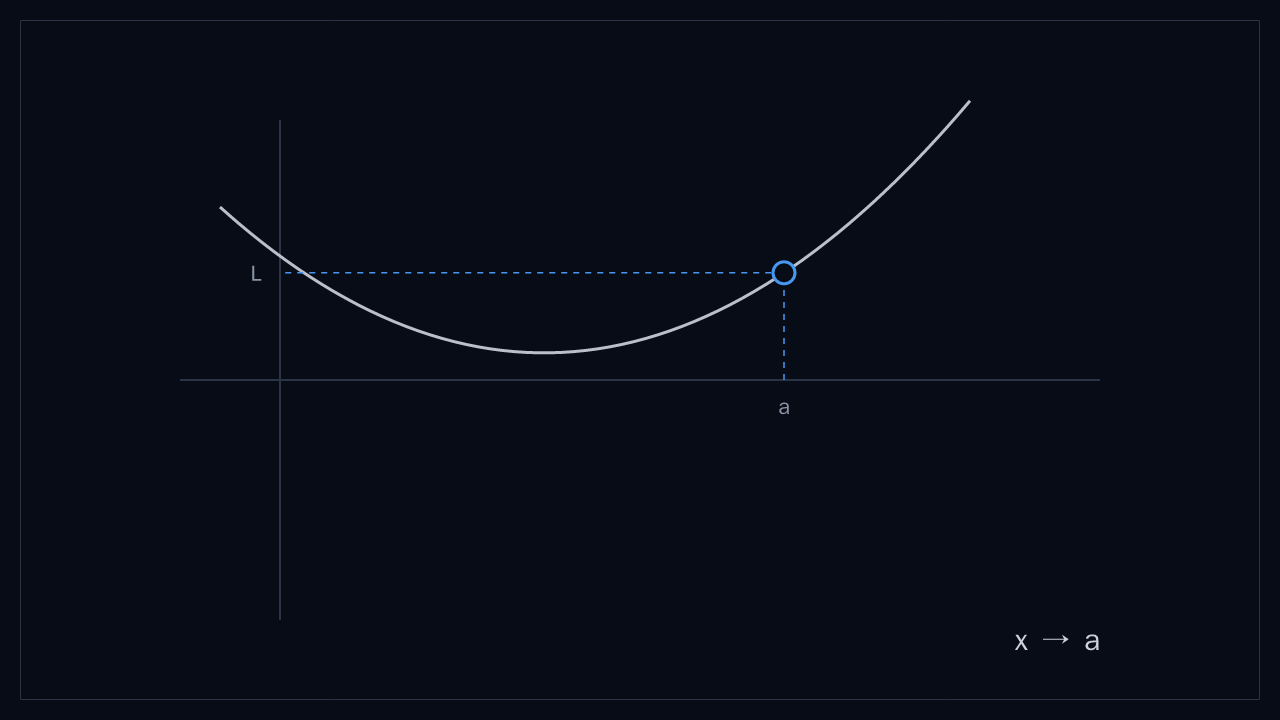
Limit questions on NET are one-line evaluations. You need about ten standard limits, three algebra moves (factorise, rationalise, divide by the highest power) and the definition of continuity. With those, a typical limit MCQ takes 30 seconds.
Key facts
- Mathematics is 50% of NET-Engineering and NET-Natural Sciences, and 30% of NET-Architecture
- Limit and Continuity is unit 12 of the Class 11 PECTAA mathematics book (National Curriculum 2023)
- Our chapter map estimates about 6 MCQs from this chapter. NUST does not publish chapter counts
Source: NUST subject weightings, verified 22 August 2026; SailToNUST chapter map
What the chapter covers
The chapter teaches you to evaluate limits algebraically, to handle one-sided limits and limits at infinity, and to test whether a function is continuous at a point. In MCQ form the continuity part becomes a limit question. A typical one asks for the value of k that makes a piecewise function continuous.
The first move on any limit is to substitute. If you get a number, that is the answer. You only need a method when substitution gives 0/0, infinity/infinity or 1^infinity.
The standard limits
lim x->a  (x^n - a^n)/(x - a)   = n a^(n-1)
lim x->0  sin x / x             = 1
lim x->0  tan x / x             = 1
lim x->0  (1 - cos x)/x^2       = 1/2
lim x->0  (a^x - 1)/x           = ln a
lim x->0  (e^x - 1)/x           = 1
lim x->0  (1 + x)^(1/x)         = e
lim x->inf (1 + 1/x)^x          = e
lim x->inf (1 + a/x)^(bx)       = e^(ab)
Rational functions as x goes to infinity, comparing the degree of the top (p) with the bottom (q):
p < q   limit = 0
p = q   limit = ratio of leading coefficients
p > q   limit is infinite
Continuity at x = a needs three things to hold together:
f(a) is defined
left-hand limit = right-hand limit
that common limit = f(a)
Worked MCQs
Five limits in the style of the practice bank, each worked and checked by us.
1. Find lim x->0 (sqrt(49 + x) - 7)/x.
Substitution gives 0/0. Rationalise by multiplying top and bottom by sqrt(49 + x) + 7:
(49 + x - 49) / [x (sqrt(49 + x) + 7)] = 1 / (sqrt(49 + x) + 7) -> 1/14
2. Find lim θ->0 (1 - cos pθ)/(1 - cos qθ).
Use 1 - cos t behaving like t^2/2 near zero:
(p^2 θ^2 / 2) / (q^2 θ^2 / 2) = p^2 / q^2
3. Find lim x->infinity (x/(1 + x))^x.
This is a 1^infinity form. Flip the fraction:
(x/(1 + x))^x = 1 / (1 + 1/x)^x -> 1/e
4. Find lim x->0 (25^x - 2(5^x) + 1)/x^2.
The top is a perfect square: 25^x - 2(5^x) + 1 = (5^x - 1)^2. So
[(5^x - 1)/x]^2 -> (ln 5)^2
5. For which k is f continuous at x = 2, if f(x) = kx + 1 for x up to 2 and f(x) = 3x - 1 for x above 2?
The left limit and f(2) are both 2k + 1. The right limit is 3(2) - 1 = 5. Set them equal: 2k + 1 = 5, so k = 2.
Common traps
- Degrees in trig limits.
lim x->0 sin x°/xispi/180, not 1. The standard result only holds in radians. sinwith different arguments.lim x->0 x^2/(sin 7x sin 5x)is1/35. Split it into(x/sin 7x)(x/sin 5x)and each factor gives1/7and1/5.- A limit that does not exist.
|x|/xgives -1 from the left and 1 from the right. When the one-sided limits differ, the limit does not exist. Look for that option before you pick -1 or 1. - Infinity minus infinity.
sqrt(x^2 + x) - xas x goes to infinity is not 0. Rationalise and you get 1/2. - Reading
1^infinityas 1.(1 + 1/x)^xtends to e, not 1. Any base that tends to 1 raised to a power that grows needs the e-limits.
How to prepare
Memorise the standard limits table first. Most NET limit questions are one of those results in disguise, with a factor of 7 or a power of 5 thrown in. Then spend a session on the trap list, because the wrong options are built from exactly those mistakes.
This chapter sits between functions and graphs and differentiation in the Class 11 book, and the derivative itself is defined as a limit. If you are short of time, the NET mathematics guide helps you decide where this chapter fits in your plan.
FAQ
Can I use L'Hôpital's rule in NET?
Yes. NET is MCQ only, so no one checks your method. It works on any 0/0 or infinity/infinity form, and it is often faster than factorising.
What is the limit of sin x over x in degrees?
It is pi/180, about 0.0175. The result 1 holds only when x is in radians.
How do I check continuity of a piecewise function quickly?
Find the value at the joining point from each formula. If both pieces give the same number and the function is defined there, it is continuous.
Is limit and continuity important for NET?
It carries about 6 MCQs on our chapter map, and it is one of the faster chapters to learn. The ideas also feed straight into differentiation.