Integration on NET comes down to four skills: knowing the standard integrals, spotting a substitution, using integration by parts, and handling definite integrals as areas. Every answer can be checked by differentiating it, which makes this the one chapter where you never need to guess.
Key facts
- Mathematics is 50% of NET-Engineering and NET-Natural Sciences, and 30% of NET-Architecture
- Integration is unit 3 of the Class 12 PECTAA mathematics book (National Curriculum 2023)
- Our chapter map estimates about 9 MCQs from this chapter. NUST does not publish chapter counts
Source: NUST subject weightings, verified 22 August 2026; SailToNUST chapter map
What the chapter covers
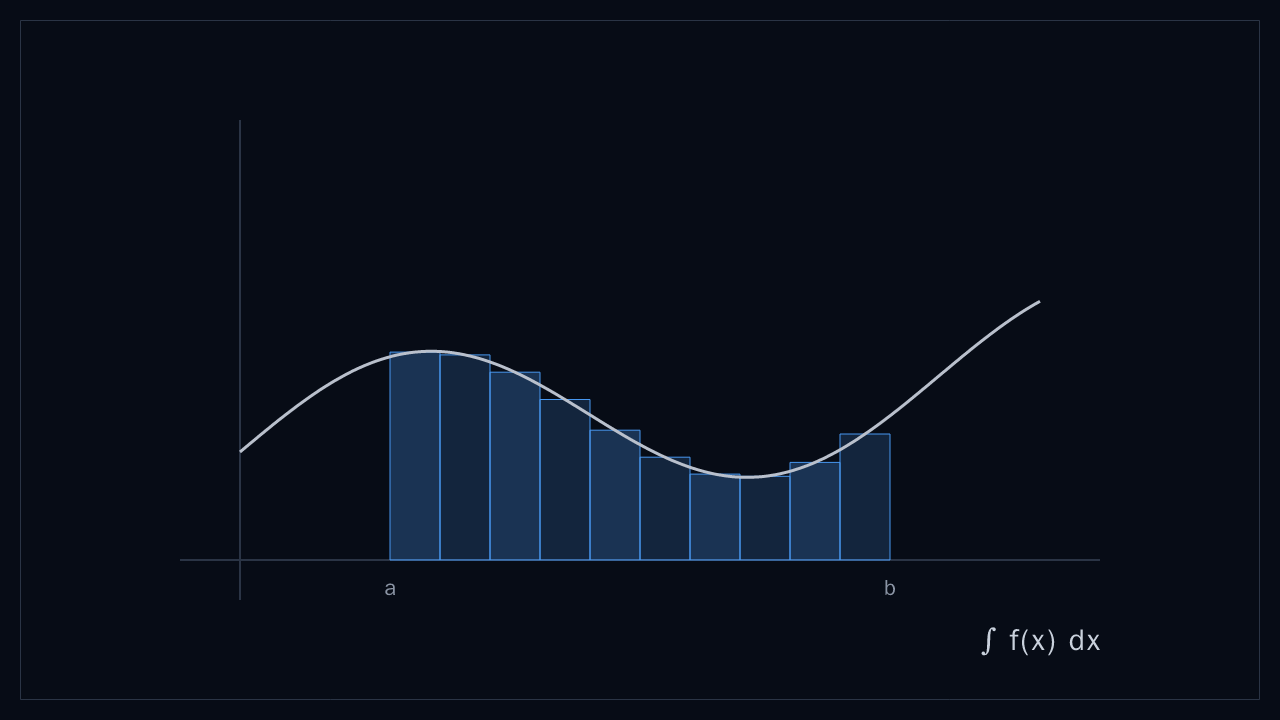
The Class 12 chapter treats integration as anti-differentiation first. You learn the standard results, then two methods for anything that is not standard: substitution and integration by parts. The last part turns the definite integral into the area under a curve.
NET questions split roughly in two. One kind asks for an indefinite integral and gives four expressions. The other gives you limits and asks for a number. The second kind is faster if you know the properties of definite integrals, because many of them need no integration at all.
Standard integrals
∫ x^n dx        = x^(n+1)/(n+1) + C,   n ≠ -1
∫ 1/x dx        = ln|x| + C
∫ e^(ax) dx     = e^(ax)/a + C
∫ a^x dx        = a^x / ln a + C

∫ sin ax dx     = -cos(ax)/a + C
∫ cos ax dx     = sin(ax)/a + C
∫ sec^2 x dx    = tan x + C
∫ csc^2 x dx    = -cot x + C
∫ sec x tan x dx = sec x + C
∫ csc x cot x dx = -csc x + C
∫ tan x dx      = ln|sec x| + C

∫ 1/sqrt(a^2 - x^2) dx = sin^-1(x/a) + C
∫ 1/(a^2 + x^2) dx     = (1/a) tan^-1(x/a) + C
Three patterns that turn most "hard" integrals into one line:
∫ f'(x)/f(x) dx          = ln|f(x)| + C
∫ [f(x)]^n f'(x) dx      = [f(x)]^(n+1)/(n+1) + C
∫ e^x [f(x) + f'(x)] dx  = e^x f(x) + C
Integration by parts, and the properties of definite integrals:
∫ u dv = uv - ∫ v du

∫[a,b] f dx = -∫[b,a] f dx
∫[a,b] f dx + ∫[b,c] f dx = ∫[a,c] f dx
∫[-a,a] f dx = 0                 if f is odd
∫[-a,a] f dx = 2 ∫[0,a] f dx     if f is even
∫[0,a] f(x) dx = ∫[0,a] f(a - x) dx
Worked MCQs
Five questions in the bank's style. We checked every answer by differentiating it back or by direct calculation.
1. Find ∫ dx / (x sin^2(ln x)).
The 1/x next to ln x is the signal. Put u = ln x, so du = dx/x:
∫ du / sin^2 u = ∫ csc^2 u du = -cot u + C = -cot(ln x) + C
2. Find ∫[1,e] (1 + ln x)/(2x) dx.
Same signal. Let u = 1 + ln x, du = dx/x. The limits change: x = 1 gives u = 1, x = e gives u = 2.
(1/2) ∫[1,2] u du = (1/2) [u^2/2] from 1 to 2 = (1/2)(2 - 1/2) = 3/4
3. Given ∫[1,6] g dx = -3 and ∫[6,8] g dx = 10, find ∫[8,1] -3g(x) dx.
No integration needed. Add the pieces, then reverse the limits and pull out the constant:
∫[1,8] g dx = -3 + 10 = 7
∫[8,1] -3g dx = -3 x (-7) = 21
4. Find ∫[0,2] |x - 1| dx.
Draw it. The graph is a V touching zero at x = 1. You get two triangles, each with base 1 and height 1, so each has area 1/2. Total: 1.
5. Find ∫ x e^x dx.
By parts, take u = x and dv = e^x dx:
∫ x e^x dx = x e^x - ∫ e^x dx = e^x (x - 1) + C
Check: the derivative of e^x (x - 1) is e^x (x - 1) + e^x = x e^x. Correct.
For area questions the method is the same as example 2. The area under y = x^2 + 1 from x = 1 to x = 4 is [x^3/3 + x] from 1 to 4, which is (64/3 + 4) - (1/3 + 1) = 24.
Common traps
- The
n = -1case.∫ x^-1 dxisln|x|, notx^0/0. Students apply the power rule out of habit. - Reversed limits. If the question puts the bigger number at the bottom, the sign flips. Example 3 above is built around this.
- Area below the axis. A definite integral of a curve below the x-axis is negative. If the question asks for area, take the absolute value of each piece separately.
- Forgetting to change the limits after a substitution. Either change them, or switch back to x before you substitute numbers.
- The
1/afactor.∫ cos 3x dxissin 3x / 3. Options often include3 sin 3x, which is the derivative, not the integral.
How to prepare
Get the derivative table fast first. Integration questions are easier when you can see a derivative sitting inside the integrand, and the differentiation guide covers those rules. Then learn the three patterns above until you spot them without thinking.
After that, do timed mixed sets. Integration also feeds the Differential Equations chapter, which shows up with order and degree questions. Keep the formula sheet open for the first week, then close it.
FAQ
Is integration hard in NET?
It is mostly standard results and substitution. The hard-looking questions usually hide a f'(x)/f(x) or e^x [f + f'] pattern that turns them into one line.
How many integration MCQs come in NET?
NUST does not publish chapter counts. Our chapter map estimates about 9 from Integration, which puts it among the biggest maths chapters. The NET mathematics guide covers how the chapters compare.
Do I need to write +C in NET?
You do not write anything, since NET is MCQ. Some options include C and some leave it out. Compare the function part and ignore the constant.
Should I learn integration by partial fractions for NET?
Yes. Partial fractions is its own chapter in Class 11, and its main use is splitting a fraction so you can integrate each piece with the ln|x| rule.